

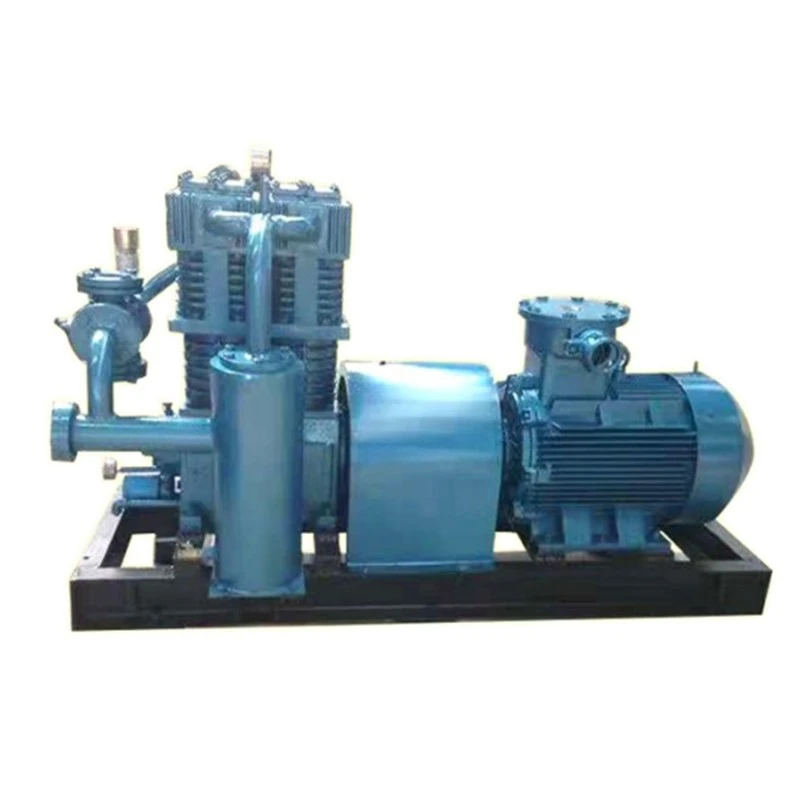
Butadiene Gas Compressor
Discover high-performance butadiene compressors designed for demanding petrochemical applications. Ensure safe, efficient, and reliable gas processing operations today.
This unit is a vertical, oil-free reciprocating piston circulation compressor, specifically engineered for applications-such as butadiene handling-that demand high medium purity. It features a highly integrated skid-mounted design combining the compressor main unit, drive motor, piping system, and four-way valve; this not only significantly reduces the equipment's footprint but also enables convenient "plug-and-play" installation and operation on-site.
Core Technologies and Structural Features
The compressor unit, drive motor, complex piping system, and core four-way valve are compactly integrated into a single assembly, drastically simplifying on-site infrastructure construction. This modular layout not only significantly reduces installation complexity but also optimizes operational workflows, making daily maintenance and start-stop control more convenient and efficient.
Core gas-contacting components-such as cylinders and packing assemblies-feature a fully oil-free lubrication design. This fundamentally eliminates the risk of lubricating oil contaminating the process medium, ensuring the high purity of the butadiene medium and meeting stringent standards for downstream polymerization and chemical processes.
- High-Pressure Lubrication for Moving Parts: The crankshaft and connecting rod mechanisms utilize a dedicated oil pump lubrication system. This ensures continuous, adequate oil-film protection for high-speed components while allowing maintenance personnel to monitor lubrication status in real time.
- Reliable Splash Lubrication: A splash lubrication mechanism is incorporated to balance structural compactness with lubrication reliability, thereby extending the service life of critical mechanical components.
Industry Applications
This compressor is primarily used in the petrochemical sector, particularly in the production of butadiene. Butadiene is a vital basic petrochemical feedstock, widely utilized downstream in the manufacture of synthetic rubber, resins, coatings, nylon, and other chemical products.
Furthermore, thanks to its oil-free lubrication, reliable sealing, and high level of integration, the compressor offers significant application value across the following industrial sectors:
Handling of Other Olefin Gases in the Chemical Industry
Suitable for the circulation, compression, and transport of olefin gases such as ethylene, propylene, and isobutylene; the oil-free design effectively prevents medium contamination by lubricating oil, thereby safeguarding downstream product quality.
Fine Chemicals and Pharmaceutical Intermediate Production
Serves as clean, oil-free gas compression equipment for fine synthesis and pharmaceutical intermediate manufacturing processes where high gas purity is required, ensuring the reaction process remains free from oil mist interference.
High-Purity and Specialty Gas Preparation
Used in preparation and filling systems for high-purity gases-such as electronic-grade gases and calibration gases-eliminating the risk of lubricant-related impurities at the source.
Tail Gas Recovery and Environmental Treatment
Used in low-pressure tail gas recovery systems across various chemical plants to compress gas streams containing organic components before routing them to downstream processing units; this facilitates material recovery while ensuring compliance with environmental emission standards.
FAQs
Q1: What are the specific requirements for the design and selection of butadiene compressors?
Due to the flammable, explosive, and self-polymerizing nature of butadiene, compressors must meet the following stringent requirements regarding design and selection:
- Material Compatibility: Flow-path components (such as cylinders, pistons, impellers, and seals) typically utilize stainless steel or special corrosion-resistant alloys to prevent corrosion by the medium.
- Explosion-Proof and Safety Standards: Electrical systems, motors, and instrumentation must possess high-level explosion-proof certification (e.g., Ex-rated); the unit must be equipped with an Emergency Shutdown System (ESD) and combustible gas leak detection devices.
- Temperature Control and Heat Dissipation: Significant heat is generated during compression; therefore, an efficient cooling system is essential to strictly control discharge temperatures and prevent localized overheating that could trigger polymerization.
Q2: What types of compressors are typically used for butadiene?
The choice of compressor type is primarily determined by process flow rate and pressure ratio:
- Centrifugal Compressor: Suitable for large-scale petrochemical main units requiring high flow rates, continuous operation, and stable pressure ratios.
- Reciprocating Compressor: Suitable for process sections requiring low-to-medium flow rates, high pressure ratios, and high precision in discharge pressure (e.g., filling operations or the initial stages of high-pressure polymerization).
Q3: What key points require attention during daily operation and maintenance?
- Pre-start Purging: Before startup, the system must be thoroughly purged and analyzed using an inert gas (such as nitrogen) to ensure oxygen and moisture levels are reduced below safety limits.
- Strict Temperature Control: Real-time monitoring of inlet/discharge temperatures at each stage and bearing temperatures is essential to prevent overheating.
- Regular Turning and Inspection: Before restarting after a long period of standby or shutdown, the compressor must be turned manually to check for binding or jamming caused by polymer formation.
- Lubricating Oil Management: Specialized lubricants compatible with butadiene must be selected to prevent reactions or severe dilution caused by contact with the medium.
Q4: What causes excessive discharge temperature in butadiene compressors, and how should it be addressed?
Excessive discharge temperature poses a significant risk, as it can trigger the self-polymerization of butadiene or even lead to an explosion. Common causes include:
- Excessive pressure ratio: The single-stage pressure ratio exceeds limits, causing an excessive temperature rise during the adiabatic compression of the gas.
- Poor cooling performance: Fouling of intercoolers, insufficient cooling water flow, or excessively high water temperature.
- Severe internal leakage: Gas valve leakage or worn piston rings, leading to the repeated recirculation and re-compression of high-temperature gas.
- Corrective measures: Immediately reduce the load, inspect the cooling system, and adjust the pressure ratio.
Hot Tags: butadiene gas compressor, China butadiene gas compressor manufacturers, suppliers, factory, ammonia refrigeration reciprocating compressor, Hydrogen Gas Compressor, industrial propylene compressor, Membrane Nitrogen Compressor, membrane nitrogen gas compressor, Propylene Gas Compressor


