

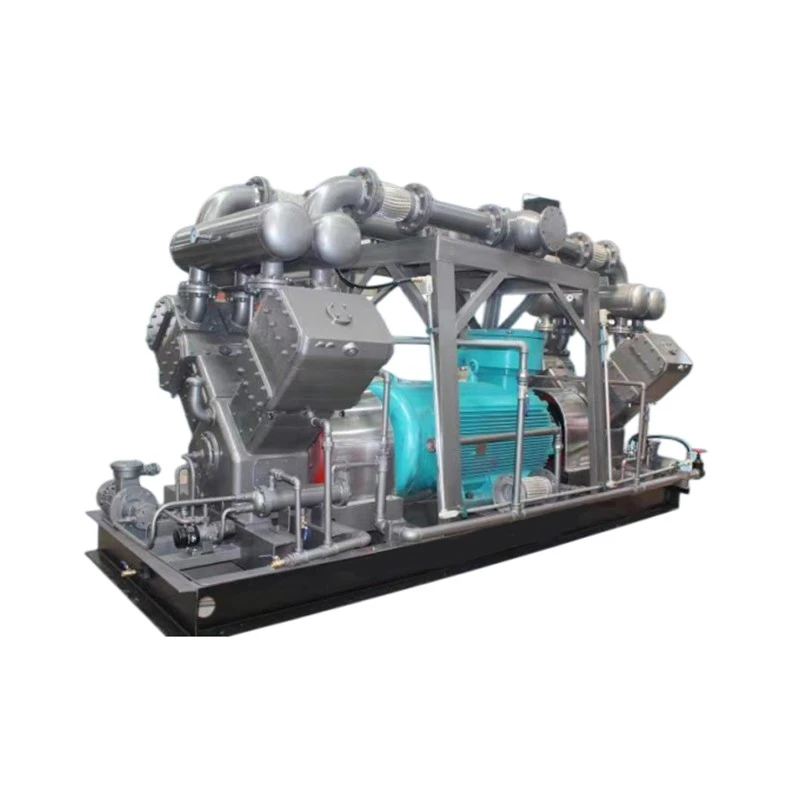
Oilfield Wellhead Gas Recovery Compressor
Customized oilfield wellhead gas recovery compressor for reinjection and CNG. Skid-mounted design. Get tailored specs for your well site.
We have launched an integrated skid-mounted processing system designed for dispersed gas sources such as wellhead gas, vented gas, associated gas from oil extraction, casing gas, and tank-top gas. The system first subjects the raw gas to buffering, pressure regulation, sedimentation, and multi-stage separation to efficiently remove free water, heavy hydrocarbons, and solid impurities. It then employs flexibly configured modules-such as desulfurization, dehydration, hydrocarbon recovery, and compression for export-to ensure the treated gas meets GB Class II standards while simultaneously recovering liquid light hydrocarbons to generate additional revenue.
Processing capacity: 3~10 × 10⁴ Nm³/d
Applicable gas sources: Oilfield associated gas, casing gas, crude oil stabilization gas, tank-top gas, pilot production vent gas, etc.
Product Features
Oilfield Wellhead Gas Recovery Compressor Core Functions
This equipment provides an integrated processing solution for oil and gas fields, addressing the following process requirements:
Oil and gas desulfurization
Hydrocarbon removal, separation, and recovery
Deep dehydration
Gas-liquid-solid three-phase separation
Compression and export
Recovery and utilization
Accounting for variations in hydrocarbon content across different oil and gas fields, the system enables the targeted separation and recovery of specific hydrocarbon components, ensuring favorable economic returns on the oil and gas products during the preliminary processing stage.
System Configuration
The entire system features a skid-mounted design, comprising the following main components:
- Oil storage/settling tank and separation unit: Handles initial buffering, gravity settling, and free water separation of the incoming raw gas;
- Cryogenic processing unit: Selected based on the hydrocarbon content of the gas; used for deep condensation and recovery of heavy hydrocarbon components;
- Hydrocarbon liquid storage and transfer unit: Safely stores separated condensate and loads it for off-site transport;
- Compressor unit: Utilizes a reciprocating piston compressor for gas pressurization and transport;
- Inlet filter and gas-liquid separator: Ensures inlet gas cleanliness and protects downstream equipment;
- Crude oil backflow prevention device: Prevents high-pressure gas or liquid from flowing back to the wellhead;
- Automatic control and metering systems: Enable operational monitoring and production data tracking;
- Explosion-proof motor: Complies with explosion-proof requirements for oil and gas facilities.
Key Features
High Level of Integration
The system integrates compression, dehydration, and gas injection functions into a single unit, housed within a sound-attenuating enclosure. Its compact, streamlined design complies with vehicle transport dimensions, facilitating lifting and on-site installation while effectively shortening the construction period.
Strong Adaptability
Equipped with a reciprocating piston compressor, the system features a wide inlet pressure design range, enabling it to adapt to actual operating conditions where wellhead pressure fluctuates throughout the production cycle. It maintains stable operation amidst pressure variations and offers relatively low power consumption, helping to reduce long-term operating costs.
Controllable Investment Costs
The highly integrated skid-mounted structure significantly reduces on-site installation workload and construction time. Furthermore, the equipment's broad adaptability to wellhead pressure fluctuations allows a single unit to serve various wellhead gas recovery scenarios, thereby minimizing the need for repeated equipment investment.
High Degree of Automation
The system features a PLC control unit and safety interlock protections to monitor and control key operating parameters in real time. Its automation capabilities support unmanned or minimally manned operations, while operational data can be uploaded to a station control system for centralized monitoring and management.
Technical Specifications

The products are tailor-made for customers from design to production, providing independent solutions based on the customer's usage requirements (flow/temperature/pressure, usage environment, main purpose and customer's special requirements).
Two Typical Configurations for Gas Source Recovery
Depending on the distribution of gas sources at the site, the system supports the following two recovery modes:
1. Single-Well or Centralized Compression and Export
Compressors are used to pressurize casing gas, which is then fed directly into a nearby gas pipeline for commingled oil-gas transport or routed to a processing station for centralized treatment. To suit actual field conditions, oil-free lubricated compressor units-specifically designed for casing gas recovery-can be selected to prevent lubricating oil from contaminating the gas quality.
2. Aggregated Recovery of Distributed Gas Sources
Low-pressure gas generated from multiple individual wells or small gas source points across a block is collected via a pipeline network to a central location; the gas is then compressed and fed into a nearby natural gas pipeline, effectively addressing the challenges associated with marginal, scattered gas sources that are difficult to process individually.
FAQs
Q1: What are the primary technical challenges faced by wellhead compressors during operation?
Wellhead operating conditions are typically far more demanding than those of conventional plant environments. Key challenges include: drastic fluctuations in gas flow and pressure-as oil and gas fields enter their mid-to-late production stages, wellhead pressure and gas output steadily decline, requiring compressors to possess broad operational flexibility (e.g., variable frequency drive, recycle control, or multi-stage cylinder unloading); risks associated with condensates and "liquid slugs"-wellheads often suddenly discharge light condensate or formation water, and if the separation system fails, this can easily cause catastrophic mechanical damage to the compressor unit; and corrosion from complex gas compositions-some wellhead gases contain high concentrations of hydrogen sulfide, carbon dioxide, and free water, which can readily trigger electrochemical corrosion or stress corrosion cracking.
Q2: What type of compressor technology is typically used for wellhead recovery compressors?
Depending on the specific discharge capacity, pressure ratio, and gas composition, two main types are employed: Reciprocating Compressors (the most common type), which are highly adaptable and suitable for applications involving high pressure ratios and low-to-medium flow rates. In oilfield environments, these often feature multi-stage compression, double-acting designs, or specialized packing configurations (such as T-type multi-stage seals) to prevent the leakage of trace amounts of hazardous gases. Rotary Screw Compressors, which are frequently used for applications requiring high flow rates and low suction pressures (including slight negative pressure); they offer a degree of tolerance for wet gas and associated gas containing liquid droplets.
Q3: How do I select the appropriate compressor specifications for a specific oil or gas well?
When selecting a unit, you need to provide the supplier with the following key parameters: Inlet/Suction Pressure (the actual pressure at the wellhead or casing, which may be near-atmospheric or a vacuum); Discharge Pressure (the pipeline pressure of the downstream gathering network or central processing station); Flow Rate (typically calculated in MCFD-thousand cubic feet per day-or Nm³/h); and Gas Composition (including hydrogen sulfide content, water dew point, molecular weight, and methane content, which determine the explosion-proof rating and material corrosion resistance requirements).
Q4: What are the key points of routine equipment maintenance?
Promptly inspect and replace gas valves: Regularly check valve temperatures, inter-stage pressures, and flow rates; repair or replace components immediately upon detecting anomalies to avoid compromising compression efficiency.
Manage liquid drainage effectively: Ensure that the drain valves on the inlet scrubber and the gas-liquid separators at each stage are functioning correctly; perform regular manual or automatic drainage to prevent accumulated liquid from being carried over into the compressor.
Monitor the engine (if applicable): If a gas engine is used for drive power, check the exhaust temperature (typically recommended to be no lower than 600°F/approx. 315°C) and ignition stability to assess whether the load is properly matched.
Address declining production: As gas wells age, consider adjusting the compressor's operating mode (e.g., switching from double-acting to single-acting) or replacing the unit with a lower-capacity model to reduce operating costs.
Hot Tags: oilfield wellhead gas recovery compressor, China oilfield wellhead gas recovery compressor manufacturers, suppliers, factory, Casing Gas And Associated Gas Recovery Compressor, oilfield casing and flare gas recovery compressor, oilfield oil well gas compressor series, Oilfield Wellhead Gas Recovery Compressor, oilfield wellhead gas recovery gathering compressor


