

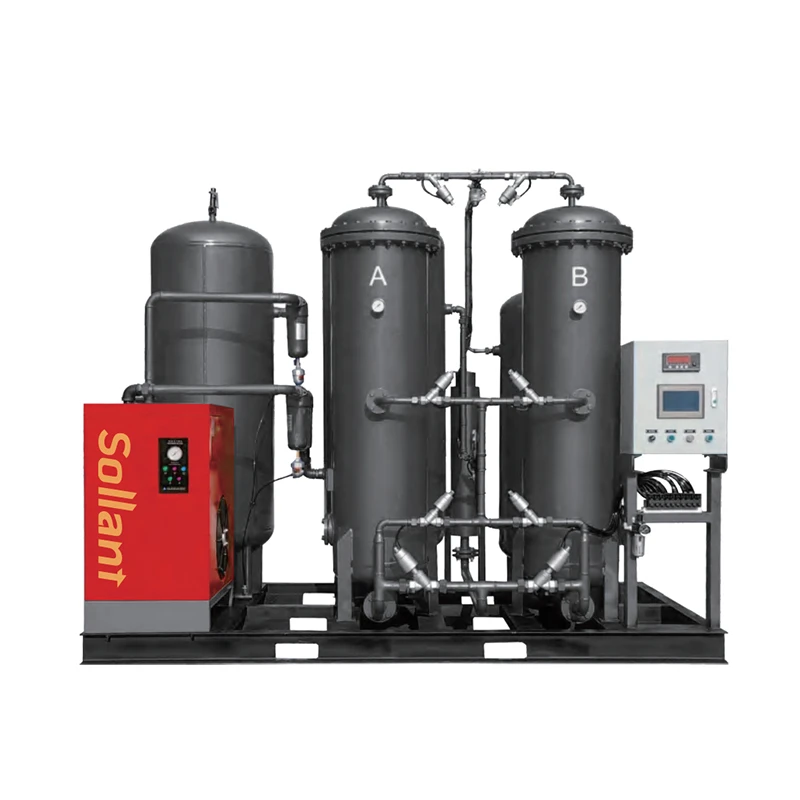
Why Choose Sollant Combined Twin-Tower Nitrogen Generator?
Choosing the right industrial nitrogen generator is essential for maintaining production efficiency, product quality, and operating cost control.
Sollant focuses on providing practical nitrogen generation solutions for different industrial applications.
1. Continuous Nitrogen Supply
The twin-tower adsorption configuration allows the adsorption and regeneration processes to operate alternately, supporting a continuous nitrogen supply when the system is correctly configured and operated.
2. Stable Nitrogen Purity
The nitrogen generation system uses molecular sieve separation technology to remove oxygen from compressed air. Nitrogen purity can be selected according to specific production requirements and equipment configurations.
3. Integrated System Design
The combined system configuration helps organize the nitrogen generation equipment and related components into a coordinated solution, simplifying installation and system integration.
4. Intelligent PLC Control
The PLC control system supports automatic equipment operation and monitoring, helping operators manage the nitrogen generation process more conveniently.
5. Flexible Capacity Options
Different nitrogen flow rates and purity requirements can be considered according to actual operating conditions, making the system suitable for a wide range of industrial applications.
6. Reduced Dependence on Delivered Nitrogen
Producing nitrogen directly at the facility can reduce dependence on gas cylinder replacement and liquid nitrogen delivery schedules, while providing greater control over the nitrogen supply.
Technical Specifications
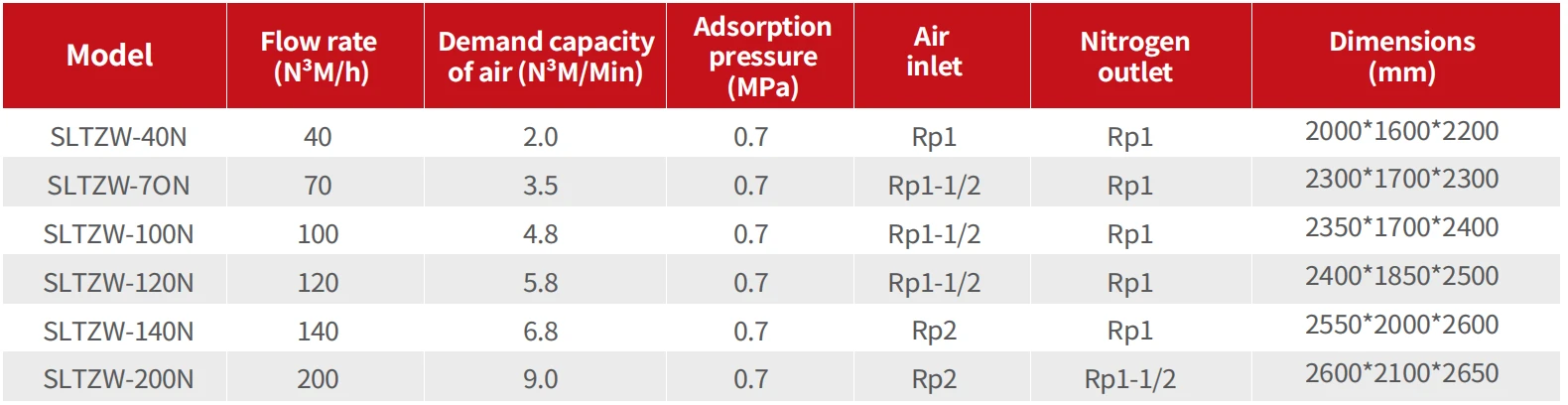
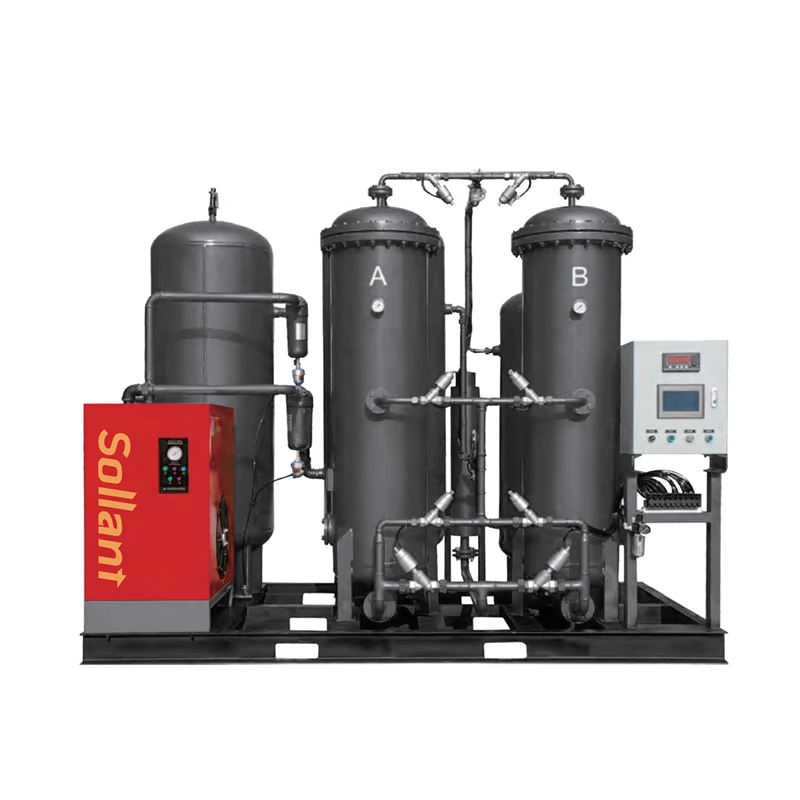
Combined Twin-Tower Nitrogen Generator System Configuration
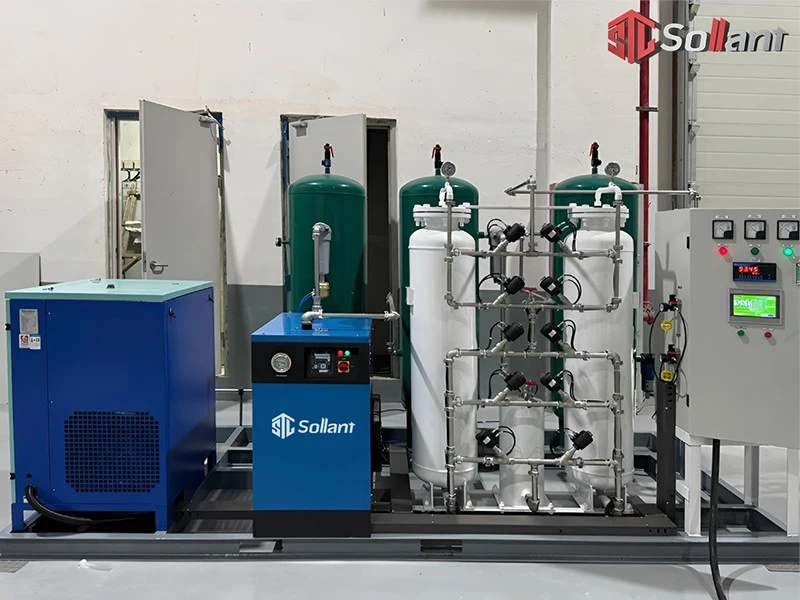
The Sollant Combined Twin-Tower Nitrogen Generator is an integrated nitrogen generation system designed to provide a stable and reliable on-site nitrogen supply for industrial applications.
Main Components and Their Functions
1. Refrigerated Air Dryer
The refrigerated air dryer removes moisture from compressed air by cooling it to condense water vapor. It helps reduce moisture entering the nitrogen generation system, protecting downstream equipment and improving operating reliability.
2. High-Efficiency Oil Removal Filters
High-efficiency oil removal filters remove oil aerosols, liquid contaminants, and other impurities from compressed air. They help protect the carbon molecular sieve (CMS) inside the PSA nitrogen generator from contamination and maintain stable adsorption performance.
3. Front Air Receiver Tank
Installed before the PSA nitrogen generator, the front air receiver tank stores and buffers compressed air. It helps stabilize air supply pressure, reduce pressure fluctuations, and provide a more consistent compressed air source for nitrogen production.
4. Twin-Tower PSA Nitrogen Generator
The twin-tower PSA nitrogen generator is the core component of the system. It uses carbon molecular sieve (CMS) to separate nitrogen from oxygen in compressed air through pressure swing adsorption technology.
The two adsorption towers operate alternately through adsorption and regeneration cycles, allowing continuous nitrogen production while maintaining the required nitrogen purity.
5. Downstream Nitrogen Process Buffer Tank
The downstream nitrogen process buffer tank stores the nitrogen produced by the generator and helps balance fluctuations between nitrogen production and consumption. It provides a more stable nitrogen supply pressure for downstream production equipment.
6. Dust Removal Filter
The dust removal filter removes particulate matter and potential adsorbent dust from the nitrogen gas before it enters the downstream application. It helps improve nitrogen gas cleanliness and protect production equipment.
7. Nitrogen Flow Meter
The nitrogen flow meter measures and displays the nitrogen output flow rate, allowing operators to monitor gas consumption and evaluate system operating performance.
How Does the Complete Nitrogen Generation System Work?
Compressed Air Drying: Compressed air passes through the Sollant refrigerated air dryer to remove moisture.
Oil and Impurity Removal: The Sollant high-efficiency oil removal filters remove oil aerosols and other contaminants.
Air Storage and Pressure Buffering: The front air receiver tank stabilizes the compressed air supply.
Nitrogen Generation: The twin-tower PSA nitrogen generator separates nitrogen from oxygen using carbon molecular sieve technology.
Nitrogen Storage: The downstream nitrogen process buffer tank stores the produced nitrogen and balances supply fluctuations.
Gas Purification: The dust removal filter removes particulate contaminants from the nitrogen stream.
Flow Monitoring: The nitrogen flow meter measures the output flow rate before nitrogen is supplied to the application.
Combined Nitrogen Generation vs. Traditional Nitrogen Gas Supply
Nitrogen is widely used in industrial manufacturing, food packaging, electronics, chemical processing, and other applications. Traditionally, businesses obtain nitrogen through gas cylinders or bulk liquid nitrogen deliveries. However, on-site nitrogen generation provides an alternative solution by producing nitrogen directly at the facility.
The Sollant Combined Twin-Tower Nitrogen Generator uses Pressure Swing Adsorption (PSA) technology to separate nitrogen from compressed air, allowing businesses to generate nitrogen according to their actual production requirements.
Comparison of Nitrogen Supply Methods
| Comparison | Combined Nitrogen Generation | Nitrogen Cylinders | Bulk Liquid Nitrogen |
| Nitrogen Source | Compressed air | Delivered gas cylinders | Delivered liquid nitrogen |
| Supply Method | On-site production | Cylinder replacement | Tanker delivery and storage |
| Gas Availability | Based on system capacity and operation | Depends on cylinder inventory | Depends on storage capacity and deliveries |
| Operating Costs | Electricity and maintenance | Gas purchase and delivery | Gas purchase, delivery and storage |
| Supply Flexibility | Configurable to demand | Limited by cylinder inventory | Limited by storage and replenishment |
| Storage Requirements | Nitrogen buffer tank | Cylinder storage area | Cryogenic storage tank |
| Suitable Applications | Continuous and regular nitrogen demand | Small or intermittent gas consumption | High-volume nitrogen consumption |
Which Nitrogen Supply Method Is Right for Your Business?
An on-site PSA nitrogen generator is worth considering when your facility has regular nitrogen consumption, requires greater control over gas availability, and wants to reduce dependence on external nitrogen deliveries.
Nitrogen cylinders may be more suitable for small-scale or occasional applications, while bulk liquid nitrogen can be an option for facilities with high gas consumption and established cryogenic storage infrastructure.
Sollant provides combined twin-tower nitrogen generation solutions to help industrial users evaluate their nitrogen supply requirements and select a suitable system.
Contact Sollant to discuss your nitrogen consumption, required purity, and operating conditions.
Installation & Site Requirements
Our combined twin-tower nitrogen generator is pre-assembled on one skid for easy installation. Before delivery, please check your site conditions:
- Power supply: Match the voltage & frequency we confirmed (220V / 380V, 50Hz / 60Hz optional)
- Compressed air source: Stable clean air supply, 0.6–0.8 MPa
- Environment: Well-ventilated workshop, ambient temperature ≤38℃, no corrosive gas, no heavy dust
- Foundation: Flat concrete floor, no special foundation required
- Space: Reserve space for heat dissipation, maintenance and component replacement
No complex piping work. After connecting compressed air and power, the unit can start nitrogen production after simple commissioning.
Project References
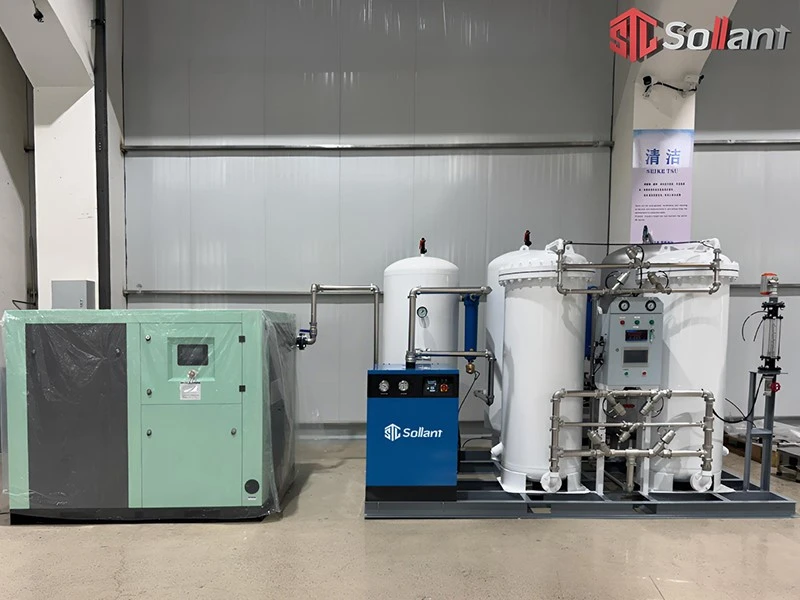
Case 1: 30 Nm³/h, 99.999% Combined Twin-Tower Nitrogen Generator for Fiber Laser Cutting
A Southeast Asian metal fabrication plant was using high-pressure nitrogen cylinders for thick plate laser cutting. Frequent cylinder changes caused production interruptions and continuously high gas costs.
They adopted our Sollant combined twin-tower PSA nitrogen generator, complete with Sollant dryer and filter package, PLC touch control and online oxygen analyzer.
- Flow: 30 Nm³/h | Purity: 99.999%
- Result: 24/7 uninterrupted nitrogen supply, clean oxide-free cutting edges, operating cost reduced by more than 60%. The compact skid unit fits well in their limited workshop space and is easy to install.
Case 2: 50 Nm³/h, 99.9% Combined Twin-Tower Nitrogen Generator for Food MAP Packaging
An Australian food manufacturer produces fresh meat and ready-to-eat snacks with MAP packaging. Their original liquid nitrogen supply suffered from large evaporation loss and expensive delivery fees.
We supplied the Sollant integrated skid nitrogen generator with full pretreatment assembly, stable low dew point output to meet food inert protection requirements.
- Flow: 50 Nm³/h | Purity: 99.9%
- Result: Consistent nitrogen purity keeps product shelf life stable. The system runs fully automatically, removes liquid nitrogen waste, and can be commissioned and put into production quickly.
Frequently Asked Questions
Q: What is the difference between combined type and split twin tower nitrogen generator?
A: Combined type is fully pre-assembled on one skid with dryer and filters integrated. It saves space, cuts installation work and commissioning time, plug and play. Split type requires separate layout and pipeline connection on site.
Q: Can nitrogen purity be adjusted?
A: Yes, purity can be adjusted between 98% and 99.999% according to your production requirement.
Q: What accessories are included in this combined unit?
A: Standard package includes refrigerated dryer, multi-stage oil removal filters, air buffer tank, twin adsorption towers, nitrogen receiver, dust filter, flow meter and control system. Booster, oxygen analyzer and remote monitoring module are optional.
Q: What maintenance is needed for PSA nitrogen generator?
A: Regular filter element replacement, valve inspection, and carbon molecular sieve replacement after several years of operation. We provide maintenance manual and spare parts support.
Q: What compressed air supply do I need for this generator?
A: Stable compressed air of 0.6–0.8 MPa is required. Clean and dry inlet air is critical to protect the carbon molecular sieve and extend service life.
Q: Can you add optional accessories like oxygen analyzer or nitrogen booster?
A: Yes. Optional parts include online oxygen analyzer, nitrogen booster, remote monitoring module and flow recording device.
Q: Does the machine require a special foundation?
A: No. A flat, well-ventilated concrete floor is sufficient. Just reserve space for heat dissipation and maintenance.
Hot Tags: combined nitrogen generator, China combined nitrogen generator manufacturers, suppliers, factory


