

By the end of this guide you will have four things in hand: a defensible duty envelope, a screened compressor type, a written specification, and a lifecycle-cost comparison you can defend to procurement. A natural gas compressor is the machine that raises gas pressure to move it through a pipeline, inject it into a well, or feed it into a process, and choosing the wrong one is expensive in a way that shows up years later. One machinery-analysis article states that 68% of reciprocating compressor failures in oil and gas trace back to application mismatch rather than component wear, though that figure comes with no published methodology and should be read as an editorial claim, not a research statistic (Flow Machinery, 2026-01-06). The steps below turn natural gas compressor selection into a sequence of decisions you can document, review, and hand to a vendor.
This guide is published by Sollant, an industrial compressor manufacturer and exporter with 22 years of international project experience. Our engineering team evaluates compressor requirements for natural gas, LPG, oilfield gas and specialty gas applications, where gas composition, operating range, pressure ratio, materials and sealing requirements can materially affect the final compressor configuration.
How to Choose a Natural Gas Compressor: The Four Decisions That Settle the Selection
Choosing a natural gas compressor comes down to four decisions made in sequence: build the duty envelope, screen the compressor type against flow and pressure ratio, match the gas to materials and sealing, then compare the surviving options on lifecycle cost. The order matters because each decision narrows the next one. Skip the envelope and you will size against a single point, which JNL Mart's gas compressor package selection guide calls "the most common cause of wrong selection."
The same source warns that selection does not end at the purchase order: a buyer who optimizes only on capital cost frequently overpays across the life of the asset, and over a 15 to 20 year life the capital-cost ranking often inverts.
Key Takeaway: Four decisions, in this order: duty envelope, compressor type, specification and compliance, lifecycle cost. Each one eliminates options before the next begins.
Before You Begin: The Duty Data You Need in Hand
Compressor vendors cannot guarantee the full duty envelope, so get data to the point that it can be defended. In our experience reviewing customized gas-compressor inquiries, incomplete duty data is one of the main reasons a technically acceptable quotation later requires changes to the compressor, driver, cooling system or control philosophy. For that reason, we recommend treating the duty envelope as an engineering document-not simply as a quotation form.
Work through the list in this order:
- Flow: minimum, normal and maximum, in the units your process data uses.
- Suction pressure and temperature: the full range, not the design point.
- Discharge pressure, then pressure ratio as absolute-over-absolute.
- Gas composition: hydrocarbons plus H₂S, CO₂, water and liquid carryover.
- Ambient and cooling conditions at the site.
- Power and utility availability, including expected transients.
Budget two to four weeks for natural gas compressor selection data gathering. Difficulty: intermediate.
Step 1: Build the Duty Envelope Before You Look at Any Compressor
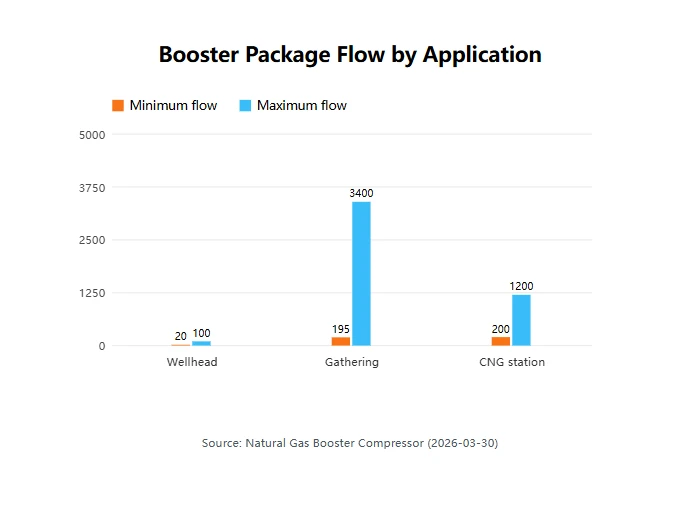
By the end of this step you will have a min/normal/max table covering flow, suction conditions and discharge conditions, plus a written list of the transients the machine has to survive.
Sizing to one design point is the most common cause of wrong selection. A single point describes a condition that occurs for a fraction of the year, so part-load behaviour, recycle and turndown get decided by accident rather than by design. For scale, one vendor's wellhead, gathering and CNG booster range spans 0.1–50 MPa discharge, 20–3,450 Nm³/h and 2–5 stages (PG Compress, Natural Gas Booster Compressor, 2026). That is one manufacturer's model range, not an industry envelope, but it shows how wide the operating window can be.
Verify your result: every row carries a minimum, a normal and a maximum, and the pressure ratio is calculated from those numbers rather than assumed.
Step 2: Screen the Compressor Type Against Flow and Pressure Ratio
By the end of this step you will have eliminated at least one of the natural gas compressor types and be holding a shortlist. The screening starts with where each family actually wins: reciprocating takes high pressure ratio at low flow, screw owns the messy middle of variable composition, wet gas, wide turndown and moderate pressure, and centrifugal takes over when flow is large, steady and clean (JNL Mart, site-dated 2026).

That maps onto the positive-displacement versus dynamic rule. If you need a lot of pressure rise out of a modest flow, you want positive displacement: reciprocating first, screw second. If you have huge, stable flow and a moderate pressure ratio, you want dynamic, meaning centrifugal. Wet, dirty or variable gas pushes you toward screw, which tolerates conditions that foul a centrifugal or hammer reciprocating valves (JNL Mart, site-dated 2026).
Then apply the per-stage limit as the decisive test. When someone insists a single-casing centrifugal can hit a 10:1 ratio, the per-stage limit tells you it cannot, not without multiple casings or intercooling that blow up the footprint (JNL Mart, site-dated 2026). A practical per-stage rule of thumb for gas compressor selection puts the ceiling at roughly 3.5 for centrifugal, 4.5 for reciprocating and 6.0 for screw (JNL Mart, site-dated 2026).
Published flow and pressure-ratio ranges for each compressor family give you the harder numbers to screen against. Reciprocating units cover 5 to 50,000 Am³/h at a per-stage ratio of 2.0 to 5.0 and an overall ratio up to 1,000:1, reaching discharge pressures up to 700 bar for reinjection, at 82% to 92% adiabatic efficiency (Projectmaterials, 2026-07-12). Screw per-stage and overall limits sit at up to 5:1 oil-flooded or 3.5:1 dry per stage and up to 25:1 overall, across 100 to 60,000 Am³/h and discharge up to about 45 bar (Projectmaterials, 2026-07-12). Centrifugal spans 500 to 300,000 Am³/h at 1.2 to 3.5 per stage and up to 100:1 overall, with 75% to 88% polytropic efficiency and centrifugal turndown before surge limited to 70–100% of design flow (Projectmaterials, 2026-07-12).
One caution on how to weigh this. These are two defensible engineering sources plus vendor product ranges, not four independent studies. Where they disagree, the per-stage figure matters more than the headline overall ratio, because the discharge-temperature limit that sets the stage count is what actually constrains a real machine: many references cite practical single-stage pressure-ratio limits around 3:1 to 4:1 to stay within a maximum discharge temperature of roughly 130–177 °C (Atlas Copco, undated product page).
Standards reference: For oil & gas applications, compressor selection and package requirements may need to be aligned with the applicable industry standard and project specification. For example, API Std 618 covers reciprocating compressors for petroleum, chemical and gas industry services; API Std 619 covers rotary-type positive-displacement compressors; and API Std 617 covers axial and centrifugal compressors and expander-compressors. The applicable edition and project-specific requirements should always be verified before final specification.
|
Family |
Flow range |
Per-stage ratio |
Overall ratio |
Max discharge |
Efficiency |
|---|---|---|---|---|---|
|
Reciprocating |
5–50,000 Am³/h |
2.0–5.0 |
up to 1,000:1 |
up to 700 bar |
82–92% adiabatic |
|
Screw |
100–60,000 Am³/h |
up to 5:1 oil-flooded / 3.5:1 dry |
up to 25:1 |
~45 bar |
not stated in source |
|
Centrifugal |
500–300,000 Am³/h |
1.2–3.5 |
up to 100:1 |
~250 bar |
75–88% polytropic |
Sources: Projectmaterials (2026-07-12) for flow, ratio, discharge and efficiency ranges; JNL Mart (site-dated 2026) for family boundaries and the per-stage rule of thumb.
Verify your result. Take the shortlisted type and check that it can reach your required overall ratio within its own per-stage limit, without extra casings or intercooling that would break your footprint or your discharge-temperature margin. If it cannot, that family is out, and you move to the next candidate on the shortlist.
Step 3: Match the Gas Composition to Materials, Sealing and Treatment
By the end of this step you have a materials and treatment requirement list derived from your own gas analysis, not from a generic datasheet.
Start with hydrogen sulfide. Any measurable H2S moves the specification into sour service: you need a material hardness limit and a documented sulfide stress cracking review, not simply a corrosion allowance. Carbon dioxide behaves differently. Dry CO2 is largely a materials question, but once liquid water is present it forms carbonic acid and attacks the same components, which is why water content and CO2 are read together rather than separately.
Water and condensate decide the sealing and treatment train. Free liquid at the suction flange means a separator or coalescing knockout upstream, interstage cooling with liquid removal between stages, and a seal strategy that tolerates carryover. This is also where gas quality starts to steer the type decision. Wet, dirty or variable gas pushes the selection toward a screw, because oil-flooded screw machines tolerate conditions that foul a centrifugal impeller or hammer reciprocating valves (DeTechtion natural gas compressor guide, 2024). In an oil-flooded screw, injected oil cools and seals the rotors as they sweep trapped gas toward discharge, a design governed by API 619 and widely deployed for wellhead gas and vapor recovery (DeTechtion, 2024). Reciprocating units pay for their efficiency with valves, rings and rods that wear, plus pulsation dampeners and heavy foundations (DeTechtion, 2024).
Verify your result: every line of the gas analysis maps to a named material, seal or treatment decision. If a component has no owner, the natural gas compressor specifications are not yet complete.
Field experience note
In actual project reviews, we have seen gas data supplied as a single "typical composition" even though the process can experience a wider operating range. For compressor selection, the design team should ask whether the quoted composition is the normal case, minimum case, maximum case or a guaranteed range. A compressor that performs well at the nominal composition may require different materials, cooling or operating limits at the edge of the specified range.
Practical check: Ask the compressor supplier to identify which gas-composition case governs power, discharge temperature, sealing, materials and driver sizing.
Step 4: Write the Specification and Set the Compliance Basis
By the end of this step you have a specification skeleton and a named standard. Which standard governs your machine follows from the type you screened in Step 2: API 618 covers reciprocating compressors, API 617 covers axial, single-shaft and integrally geared centrifugal and expander-compressors, API 619 covers rotary positive-displacement machines including screw, and ISO 13631 covers packaged, skid-mounted reciprocating units in petroleum and natural gas service. ASME PTC 10 is the performance test code that typically sets factory acceptance test methodology. Treat these as the governing scope, not as clause text to copy: the standard documents themselves were not read here, so the vendor's compliance statement is what you check against the current edition.
Fix five items in the specification before you issue it:
- Control philosophy and turndown. State the required turndown range, the control mode (suction pressure, discharge pressure, flow), and whether the machine must run in recycle or unload. Turndown drives the driver sizing and the bypass arrangement.
- Driver type and starting method. Name the driver (electric motor, gas engine, turbine) and whether speed control is by VFD or by a bypass and throttle valve. VFD gives continuous speed control at higher capital cost; bypass is cheaper but wastes energy at part load.
- Pulsation and vibration limits. Reference the applicable API limit and require a pulsation study for reciprocating machines. Forcing the vendor to submit the study with the bid prevents a late-stage redesign.
- Nozzle and interface schedule. Fix nozzle sizes, ratings, orientation, utility connections, and the battery limit between vendor package and plant.
- Documentation deliverables. List what must arrive before award: datasheets, performance curves, P&ID, general arrangement drawing, utility consumption, and the compliance statement.
Pro Tip: the pre-award documentation checklist is where most selections stall. Ask for the datasheet, performance curves, P&ID, GA drawing, utility list, and standards compliance statement as one package, and make the bid technically incomplete without it.
On discharge temperature, staging and intercooling, not brute force, is what controls it. Atlas Copco notes that its BBR range reaches low discharge temperatures "through proper staging and large, oversized high-efficiency intercoolers," and that a crankcase rated to 35 bar(g) keeps gas in and saves 2 to 6 percent versus unsealed compressors (Atlas Copco BBR). Write the intercooler duty and cooling medium into the specification rather than leaving them to the vendor.
Verify your result: The specification should also identify which requirements are mandatory and which are project preferences. For example, an oil & gas project may reference API standards, while hazardous-area requirements, pressure equipment requirements, electrical requirements and local regulations may come from different authorities. Certifications such as CE or explosion-protection certification should be stated according to the actual equipment configuration, destination market and applicable conformity requirements rather than treated as generic product attributes.
Step 5: Compare Options on Lifecycle Cost, Not Purchase Price
Run the comparison against the actual duty cycle, not the design point. A machine specified for a single operating case looks efficient on paper and expensive in service, because most packages spend their life somewhere other than the rated condition. Over a 15 to 20 year horizon the capital-cost ranking often inverts: a cheaper fixed-speed unit that lives on recycle can consume more in energy than a variable-speed machine that cost more up front (JNL Mart, Gas Compressor Selection).
Energy dominates the life-cycle cost of compression. Atlas Copco's compressed-air experts put energy at roughly 76% of the total, investment at 14% and maintenance at 10%. Treat that as a vendor estimate, not industry consensus: the same split recurs on Atlas Copco's own regional blog and is re-reported by third-party sellers, so it is one source. Its original context is compressed-air systems generally, not natural-gas packages, and a CNG compressor running a station duty cycle will weight those shares differently.
Pro Tip: Build the comparison on your own load profile, and write the assumptions next to the numbers. A lifecycle table without its duty cycle and fuel or power price is a purchase-price table with extra columns.
Maintenance is the smaller share but the one that decides availability, and the maintenance profile of each family differs by mechanism. Reciprocating units carry the highest routine load: valves, piston rings and packing are consumables on defined replacement intervals, and valve temperature is a leading indicator worth trending. Screw machines sit in the middle, with the lube-oil system, oil-separation coalescers, bearings and slide valve as the parts to watch. Centrifugal packages have the lowest routine load and the longest overhaul intervals, but overhauls are specialist work and condition monitoring is not optional (JNL Mart, Gas Compressor Selection).
Verify your result: the comparison runs on your load profile, states its power or fuel price, discount rate and evaluation period, and shows the maintenance intervals you assumed for each family. If any of those is missing, the ranking is not yet defensible.
Compare configurations: put two or three screened options side by side against the same duty envelope and the same assumptions before you shortlist.
Step 6: Verify the Result and Close the Pre-Award Package
By the end of this step you have a selection that survives its own worst case, plus a question set each bidder answers in writing.
Re-run the shortlisted type against the maximum and minimum points of the duty envelope, not the midpoint. Confirm turndown and part-load behaviour at the minimum, because a machine sized for the peak can be unstable or inefficient at the low end. Check the driver and utility basis again: power available, fuel gas quality, cooling medium, ambient range. Then confirm the documentation and test scope match the specification you wrote in Step 4, including the performance test standard and witness points.
The pre-award package holds five items: the duty envelope, the specification, the compliance basis, the lifecycle cost comparison, and the bidder question set. Send all five to every bidder so the quotes come back comparable.
A packaged reciprocating unit can be used to illustrate this: a multi-stage machine reaches higher pressures in steps, and cylinder unloaders let it follow a swinging wellhead or gathering duty without a second frame (DeTechtion, 2024). Specify it against your envelope, not the vendor's reference case.
Common Mistakes That Break a Compressor Selection
Sizing to a single design point. Most selection errors start here: the compressor is matched to one flow and pressure condition, then the plant runs at another for most of the year. The fix is to specify across the whole duty envelope, with the normal case, the turndown case and the upset case all named.
Screening by flow alone. A flow figure says nothing about whether a reciprocating machine can reach the discharge pressure in the stages available. The per-stage pressure-ratio limit tells you it cannot, so screen on flow and ratio together before you shortlist.
Treating one vendor's cost split as industry consensus. A widely circulated 76/14/10 breakdown of capital, installation and operating cost is one vendor's estimate, not industry consensus. Use it as a starting shape for your own model, then replace each line with your own quoted numbers.
Specifying a centrifugal for wet, dirty or widely varying gas. Liquid carryover, particulates and swinging molecular weight are conditions that foul a centrifugal and erode its head. If your gas analysis shows any of them, the burden shifts to upstream treatment or to a different machine type.
Optimizing on capital cost against the design point. A cheaper package that only performs at the design point will cost more over the duty cycle than a pricier one that holds efficiency across the range. Compare on lifecycle cost at the hours you will actually run.
Before you commit, put these to each bidder: what is guaranteed at the minimum envelope point, what the performance test covers, which documents ship with the unit, and what changes the price if the gas analysis shifts.
What Success Looks Like
A finished selection has four checkable parts. First, a screened compressor type that reaches the required overall pressure ratio within its per-stage limit, so no stage is asked to carry more compression than its design allows. Second, a duty envelope with min, normal and max defined for every parameter, not a single design point. Third, a specification naming its governing standard, its materials, its sealing arrangement and its control philosophy, so two vendors are quoting the same machine. Fourth, a lifecycle comparison built on your own load profile, with every assumption about run hours, fuel or power cost and maintenance interval written down where a colleague can challenge it.
If those four hold, you can defend the choice to operations, procurement and finance without re-opening the technical case.
A reasonable stretch goal is to extend that same comparison to driver electrification or remote monitoring. Both are established options today, and adding them as line items in the lifecycle model costs little once the load profile already exists.
Frequently Asked Questions
Q: How long does a compressor selection exercise take?
A: The timeline depends on how complete the process data is and whether the project requires multiple engineering reviews. For a straightforward duty with complete gas composition, flow, suction/discharge pressure and utility information, an initial technical screening can be relatively quick. More complex projects involving specialty gases, wide operating ranges, high pressure, hazardous areas or customized materials require additional engineering review. In our project experience, delays are more often caused by missing or changing duty data than by the compressor selection itself.
Q: Can a screw compressor replace a reciprocating unit for a given duty?
A: Sometimes, and the deciding variables are pressure ratio and flow stability. Oil-flooded screw packages handle moderate pressure ratios well and tolerate liquid carryover, which suits many gathering and fuel-gas duties. Reciprocating units remain the default where the pressure ratio is high, where flow varies widely, or where discharge temperature must be held inside a defined limit. Compare the two against your actual envelope rather than against a general preference.
Q: What happens if the gas composition changes after installation?
A: Performance drifts before anything fails. Higher molecular weight raises compression power and discharge temperature; heavier hydrocarbons and water increase the risk of condensation and hydrate formation in the package. Build the specification around a stated composition range, not a single analysis, and confirm with the vendor which end of that range sets the driver rating.
Q: How do turndown requirements change the driver and control choice?
A: Wide turndown pushes you toward a variable-speed driver, suction valve unloading, or a recycle arrangement, and each carries a different efficiency penalty at part load. State the minimum and maximum flow the process will actually see, because a package sized only for the design point often cannot be controlled at the low end.
Q: Is a used or rented package a reasonable route?
A: For short campaigns or bridging capacity, yes, provided the pressure rating, materials and certification history can be documented. The risk sits in the internals: seals, valves and coatings may have been selected for a different gas. Budget for inspection and re-rating before committing, and treat the lifecycle cost comparison in Step 5 the same way you would for a new unit.
Next Step: Take the Envelope to an Application Engineer
You now have a duty envelope, a screened compressor type, a materials and treatment basis, a written specification, and a lifecycle cost comparison you can put side by side with any quotation.
That package is what lets you defend the selection in an internal review instead of arguing from a vendor brochure. The numbers came from your site data, and the trade-offs are documented.
The next move is a technical conversation, not a purchase order. Take the envelope to an application engineer and ask for a selection datasheet that states the frame, the pressure ratio, the materials of construction, and the utility demand for your exact duty point. Ask what changes if your flow or suction pressure moves 20 percent either way, and ask which assumptions in the datasheet are guaranteed and which are estimates. A supplier who answers those questions in writing has earned the next stage of the evaluation.