

Buying an LPG compressor means comparing dozens of near-identical vendor pages that rarely state the same numbers in the same units. This LPG compressor buying guide replaces that with seven factors, each anchored to a standard or a measurable duty parameter, so you can rank options against your own requirements instead of a brochure.
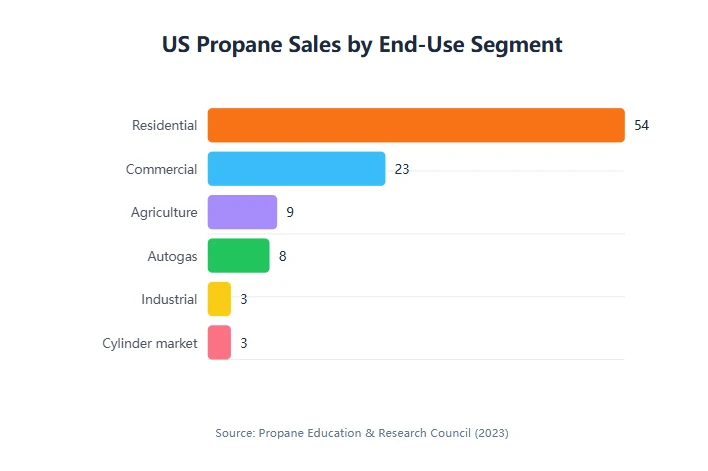
The category is large enough that the comparison problem is real: US odorized propane sales reached 8,995 million gallons in 2023, with residential use at 54% and commercial at 23% (PERC's 2023 retail propane sales report). Supply points number roughly 13,500 bulk and storage facilities (NPGA's Facts About Propane), and public autogas stations sit near 4,175, though a second source counts about 2,500 (the DOE's Alternative Fuels Data Center station count).
This is a research-only review. No compressor was tested, no vendor supplied equipment, and every figure below comes from a published source or a named standard. You will finish with a fillable duty-envelope worksheet and a decision framework for LPG compressor selection, including how to choose an LPG gas compressor when two quotes look equivalent on paper.
This guide is published by Sollant (Shanghai Sollant Energy Saving Technology Co., Ltd.), a manufacturer and supplier based in China that develops and produces gas compression equipment, including screw and piston compressors and specialized systems for oilfield and nitrogen generation. The company's work covers diaphragm and high-pressure piston compressor technology and customizable compression solutions for specialty gases, which is the equipment category this buying guide addresses.
LPG Compressor Buying Guide: Start With Your Duty Envelope, Not a Vendor
Before you compare a single catalog page, write down six numbers and two classifications. That worksheet, not the brochure, decides which machine fits: flow in CFM or m³/h, suction and discharge pressure as bar(g)/psig pairs, gas composition (propane/butane ratio, odorized or not), duty cycle (continuous, intermittent tanker unloading, or cylinder filling), ambient temperature range, and hazardous-area classification.
The reason is regulatory, not theoretical. OSHA's LP-Gas storage and handling rules require compressors to draw from the vapor space of the container being filled and discharge to the vapor space of the container being emptied, so suction conditions follow your vessel arrangement rather than a vendor's default.
Duty profiles vary enormously across the US market. NPGA's Facts About Propane counts roughly 13,500 bulk and storage distribution points alongside about 162,000 cylinder refillers, and a terminal unloading at 20 bar(g) shares little with a cylinder-filling plant cycling every few minutes. Fill the worksheet first; every later factor in this guide reads from it.
Pro Tip: Record these worksheet fields before contacting any supplier: flow (CFM / m³/h); suction and discharge pressure (bar(g) / psig pairs); gas composition (propane/butane ratio, odorized or not); duty cycle (continuous vs intermittent tanker unloading vs cylinder filling); ambient temperature range; hazardous-area classification.
Factor 1: Match Compressor Type to the LPG Duty Profile
The first LPG compressor selection error is choosing by price rather than by duty profile. Each machine type owns a different job, and the compression ratio your process demands usually decides which one is even viable.
The Texas A&M Turbomachinery Laboratory's compression-ratio guidance gives the clearest starting filter: single-stage machines cover roughly 1:1 to 5:1, two-stage covers about 5:1 to 8:1 (or 8:1 to 12:1 depending on gas and cooling), and duties above roughly 12:1 call for three or more stages. Note that this type-comparison framing traces to a cluster of practitioner and vendor teaching documents rather than independent measurement, so treat the bands as a screening tool, not a specification.
LPG adds two constraints that generic air-compressor guides omit. Liquid carryover destroys reciprocating machines, and NFPA 58's liquid-carryover rule for compressor suction requires compressors to be built or equipped with auxiliary devices that prevent LP-gas liquid from entering the suction, with portable units on temporary connections excepted (2001 edition archive copy; confirm against the current edition). Vapor-recovery duty also swings widely, so turndown matters as much as peak flow.
|
Type |
Duty profile |
Ratio range |
Liquid tolerance |
Typical LPG application |
|---|---|---|---|---|
|
Reciprocating |
High ratio, low-to-medium flow |
Up to 12:1+ in stages |
Low; needs separation |
Vapor recovery, transfer, bottling |
|
Screw |
Medium ratio, high flow |
~3:1 to 8:1 |
Moderate |
Bulk transfer, terminal duty |
|
Rotary vane |
Low-to-medium ratio, compact |
~2:1 to 5:1 |
Low |
Small transfer, low-flow recovery |
|
Diaphragm |
Low ratio, contamination-sensitive |
~2:1 to 4:1 |
Very low |
Sampling, specialty gas |
|
Centrifugal |
Low ratio, very high flow |
~1.5:1 to 3:1 |
High |
Large terminal, high-volume |
The process engineer's question to the vendor: which duty profile did you size against, and what happens to this machine when suction pressure swings or liquid carries over?
Factor 2: Size for the Real Operating Envelope, Not the Nameplate
Nameplate capacity is a point rating taken at one suction pressure and one ambient temperature. Your plant does not operate at a point. It operates across a range: suction pressure swings 2–6 bar(g) during tanker unloading, and the compressor then sits through the highest ambient the site sees in July.
Documented LP-gas compressor lines illustrate how wide the published span is. Corken's bulk-plant LPG compressor line is catalogued from roughly 4.1 to 117 CFM, with the catalogue extending to about 414 CFM; Blackmer's LP-gas compressor range runs roughly 7 to 125 CFM. Those are catalogue spans, not recommendations, and the correct figure for your site is the one that holds at worst-case suction, not at the rating point.
Two thresholds do most of the sizing work. First, compression ratio: a high ratio raises discharge temperature, and discharge temperature is what shortens valve and ring life. Second, differential: Blackmer's guidance on keeping the transfer differential low suggests liquid-transfer installations hold no more than about 1.4–2 bar (20–30 psi) between inlet and discharge. That is a manufacturer guideline, not a code requirement, but it is a useful sanity check on any proposed package.
Key Takeaway: Size against worst-case suction and peak ambient, then confirm the resulting compression ratio leaves discharge-temperature headroom.
Operations managers should ask one question of every vendor: what is the turndown at minimum suction, and what happens to capacity at peak demand? A unit that meets the nameplate and fails the unloading window is the most common sizing error in bulk and bottling plants.
Factor 3: Map Standards and Hazardous-Area Classification to Concrete Selection Decisions
Each standard in a brochure should change one specific line in your LPG compressor specifications. That is the test for whether it belongs in the RFQ at all.
Start with pressure relief, the clause most often left to the vendor. OSHA requires every LP-Gas container, other than a DOT-constructed container, and every vaporizer to carry one or more spring-loaded or equivalent safety relief valves arranged for free vent to outer air, discharging at least 5 ft horizontally from any building opening below the discharge (29 CFR 1910.110, current CFR text). The same section fixes start-to-discharge settings against container design pressure and requires a relief valve at or near the vaporizer discharge, sized to the required effective rate of discharge. Write both as separate specification line items; a package meeting one and not the other is not compliant. NFPA 58 adds the liquid-entrance-prevention requirement on the suction side, so confirm the edition your jurisdiction enforces before citing a clause number.
The API choice then sets the auxiliary scope. API 618 governs reciprocating compressors and API 619 covers rotary screw and lobe machines in petroleum, petrochemical and gas service; API 618 is what pulls pulsation suppression, pulsation and mechanical analysis, and the associated auxiliary scope into the purchase specification, while API 619 excludes general-purpose air, liquid-ring and vane machines (ADNOC reciprocating compressor specification, October 2021; Gardner Denver API standards white paper, undated). On reciprocating duty, the pulsation study is a deliverable, not an option.
Hazardous-area classification closes the loop on electrical and instrumentation specification. ATEX and IECEx Zone 0, 1 and 2 map to equipment categories Ga, Gb and Gc, and NEC Class I Division 1 and 2 describe the same risk in different vocabulary. Whichever frame your site uses, the zone decides motor enclosure, instrument certification and junction-box rating. No independent test data was found comparing package compliance across vendors, so treat the certificate set as the evidence rather than a marketing claim.
Key Takeaway: Put each standard where it belongs in the RFQ. Relief-valve arrangement and start-to-discharge settings go in the safety and pressure-relief line; NFPA 58 liquid-entrance prevention goes in the suction and process line; API 618 or 619 goes in the scope-of-supply and analysis line; area classification goes in the electrical, instrumentation and motor line.
Procurement's question to every bidder: which certificates ship with the unit, and which are only promised in the proposal?
Factor 4: Build the Total Cost of Ownership Model From Its Four Components
Lifecycle cost is energy plus maintenance plus spares plus downtime, and you should build that model yourself rather than accept a vendor's percentage. The compressor cost-of-ownership guides published by Kaeser, Quincy and SCC put energy at roughly 70 to 80 percent of lifetime cost, maintenance at 10 to 15 percent and purchase at 10 to 20 percent, with one summary stating 76 percent energy, 14 percent investment and 10 percent maintenance. Treat those as a single upstream cluster derived from air-compressor practice, not LPG-specific measurement; the formula structure is corroborated by DOE/EPA-style energy-cost methodology, the split itself is not. That gap is exactly why an LPG compressor total cost of ownership has to be modelled on your own numbers.
Start from the energy term, because it dominates:
annual energy cost = shaft power (kW) × annual running hours × electricity price per kWh ÷ motor efficiency
Plug in the duty envelope from the first section: the flow, suction and discharge pressures, gas composition and duty cycle you wrote down there determine shaft power and running hours. Then add maintenance and spares from the vendor's stated intervals, and downtime. Industry downtime-cost roundups from MaxGrip and Seqent put unplanned downtime for oil and gas operations at roughly $250,000 to $500,000 per hour. Use that as a directional range to size the risk, not as a line item you can predict.
For executives: what payback period does the model produce, and does the package scale if throughput grows?
Factor 5: Evaluate the Vendor, the Package Scope and the Delivery Schedule
The compressor block is one line of the purchase specification. The package scope, controls integration, spares availability and lead time decide whether the plant actually runs. Vendor-published LPG compressor package delivery schedules put custom engineered units at typically 12 to 16 weeks, stretching to around 24 weeks for complex custom systems (PanGeng Gas, retrieved 2026-05-27). Treat that as a planning input for your project schedule, not a benchmark: it is vendor content, and no independent delivery dataset was found.
Controls and telemetry deserve their own line in the evaluation. Ask whether the package ships with SCADA/PLC integration, vapor-recovery automation and fault early-warning, or whether those are add-ons you will pay to retrofit.
Sollant's ZW-series LPG reciprocating compressor shows how one vendor frames its package: a vertical oil-free reciprocating design supplied as an integrated unit with explosion-proof control system, real-time monitoring and fault early-warning. The packaged ZW unit with its integrated separator and safety valve is a replicable example of the scope to demand in writing. The vendor's efficiency and lifecycle claims are qualitative, and its published numeric ratings sit inside a specification image, so verify every figure against the certified datasheet before you compare quotes.
For procurement, the closing question is simple: what are the spare-parts lead times, warranty terms and after-sales response commitments, in writing?
Factor 6: Separate Must-Have Criteria From Red Flags, Then Decide
Two lists turn five quotes into one decision. Apply the must-haves first: each one eliminates a vendor outright, so you never spend time scoring a package that cannot do the job. Then use the red flags to decide how hard you question whoever is left.
The must-haves consolidate what factors 1 through 5 established. A documented duty-envelope match, not a nameplate figure. Liquid-carryover prevention designed to OSHA 1910.110(b)(14)(xi) and NFPA 58. An API 618 or 619 scope that names which standard governs the package. Hazardous-area certification for the classified zone. An itemised total cost of ownership model. Named spare parts with a stated lead time.
Red flags are different: they do not disqualify, they trigger questions. Capacity quoted without a duty envelope. No certified datasheet. Standards cited without clause or scope. TCO asserted as a single percentage. No after-sales terms.
|
Must-have (eliminates) |
Red flag (question further) |
|---|---|
|
Documented duty-envelope match |
Capacity quoted with no envelope |
|
Liquid-carryover prevention per OSHA 1910.110(b)(14)(xi) and NFPA 58 |
No certified datasheet |
|
Correct API 618/619 scope |
Standard cited without clause or scope |
|
Hazardous-area certification |
Certification claimed, not evidenced |
|
Itemised TCO model |
TCO as one percentage |
|
Named spares and lead time |
No after-sales terms |
The decision rule depends on your duty. If the duty is intermittent liquid transfer with a tight pressure hold, prioritise type and sizing, because those determine whether the machine holds setpoint at all. If the site is classified and continuously manned, prioritise compliance and controls integration, because those determine whether it can run unattended and pass inspection.
Key Takeaway: Must-haves eliminate; red flags only trigger questions. Apply them in that order, and let your duty profile decide which criteria carry the most weight.
One question for the technical director: who signs off on each criterion, and does a failed must-have need engineering review or is it an automatic no-bid?
Frequently Asked Questions
Q: How do I choose between a reciprocating and a screw LPG compressor for a bulk plant?
A: Start with the duty profile, not the technology. Reciprocating machines suit high-pressure-ratio, low-flow duty such as vapor recovery and cylinder filling. Rotary screw machines suit higher, steadier flows at lower pressure ratios, such as terminal transfer duty. The API scope split reflects this: API 618 for reciprocating, API 619 for rotary screw duty. Intermittent flow with high discharge pressure points to reciprocating; continuous flow with small pressure lift points to screw.
Q: Is a free or low-cost compressor adequate for production LPG service?
A: Rarely, and the reason is the cost structure rather than the sticker price. The compressor cost-of-ownership guides that break the total into components consistently show energy, maintenance and downtime outweighing the initial purchase price over the machine's life. These guides come largely from vendor and trade clusters, so treat the split as directional rather than measured. A cheap unit that runs inefficiently, needs frequent attention, or lacks hazardous-area certification costs more in the first two years than it saved at purchase.
Q: What is the difference between API 618 and API 619 in practice?
A: API 618 covers reciprocating compressors and API 619 covers rotary screw compressors. In practice the difference shows up in what the vendor must document: pulsation analysis, vibration limits and rod-loading calculations for reciprocating duty; rotor, bearing and capacity-control detail for screw duty. Specify the standard matching your machine type, and check that the vendor's documentation actually addresses it rather than citing it on the cover page.
Q: Do I need a paid package for hazardous-area installation?
A: Yes, if the compressor sits in a classified zone. The package scope must carry the hazardous-area certification for the zone and gas group, and that certification is a paid engineering deliverable, not an option. Certification follows the zone classification, not the number of sites operating in the regulated space.
Conclusion
Read the seven factors as a sequence, not a checklist. Fill in your duty envelope first: flow, suction and discharge pressure, gas composition, duty cycle, ambient conditions and site classification. Everything after that follows from those numbers. Compressor type and sizing are decided by the envelope. Compliance and controls integration are decided by the classification. Total cost of ownership and vendor evaluation are decided by the package scope and the delivery schedule. The two-list exercise closes the loop, because writing your must-haves and red flags down before you talk to anyone is what keeps a vendor's framing from becoming your criteria.
The decision rule is simple. If your duty is intermittent liquid transfer with a tight pressure hold, prioritise type and sizing. If the site is classified and continuously manned, prioritise compliance and controls integration.
That is the whole of this LPG compressor buying guide: build the envelope, then let it choose the machine.
Once your duty envelope is filled in, the fastest way to test it against real hardware is to request a selection datasheet or talk to an application engineer. Bring your flow, pressure and duty-cycle figures and ask for a written selection basis against them.