

Hydrogen compression is rarely a question of whether, only of which. If you are reading this, you already know your process needs a compressor and you are now comparing technologies against a defined envelope. Four parameters decide that choice: suction and discharge pressure, capacity in kg/h or Nm³/h, required purity and dew point, and duty cycle. Station pressure levels make the spread concrete, from 700 bar for passenger fuel-cell vehicles to 350 bar for buses and heavy-duty trucks, with storage systems running 500-900 bar (Atlas Copco's station pressure table). Technology selection across the value chain follows mainly pressure level, flow rate, and whether purification must be combined with compression (Hyfindr's compression overview).
This guide is a reference, not a pitch. Each section stands alone: a comparison of hydrogen compressor types, an application map, a selection framework with a worked example, and the materials, standards and lifecycle-cost criteria an RFQ has to carry. It draws on published review literature, OEM technical documentation and standards bodies.
What a Hydrogen Compressor Does and Where It Sits in the Value Chain
A hydrogen compressor raises hydrogen gas from a source pressure to a delivery pressure, usually through staged compression with intercooling between stages. It is the moving part of the hydrogen value chain: gas arrives from an electrolyzer outlet at near-atmospheric pressure for alkaline units or roughly 8 to 30 barA for PEM units, passes through purification and storage, and leaves as a dispensed product.
That placement defines its duty. Station pressure levels run at 700 bar for passenger fuel-cell vehicles and 350 bar for buses and heavy-duty trucks, with station storage systems held between 500 and 900 bar (Atlas Copco, page dated 2026-08-25). Three duty families follow from this: production-side compression, storage and transfer, and dispensing.
Hydrogen compressor pressure and flow range, not brand preference, decides the technology. Required pressure level, flow rate, and whether purification must be combined with compression drive the choice, with reciprocating piston and diaphragm units dominating most gaseous duties (Hyfindr, undated). The types section compares those families directly; the applications section maps them back onto each duty. One limit applies throughout: public performance data is thin for emerging non-mechanical options, so their maturity claims rest on narrower evidence than the mechanical families.
Hydrogen Compressor Types: How the Main Technologies Compare
Hydrogen compressor types split into mechanical and non-mechanical families, and three numbers decide between them: required flow, discharge pressure, and allowable contamination.
|
Technology |
Typical flow range |
Typical discharge pressure |
Purity capability |
Maturity |
Best-fit duty |
|---|---|---|---|---|---|
|
Diaphragm |
350–1,100 Nm³/h |
300–550 barg |
Oil-free, high purity |
Established |
Electrolyzer-coupled, high-purity |
|
Reciprocating piston |
Wide, low to tonnage |
Up to 1,034 bar |
Seal-dependent |
Established |
Refuelling, high pressure |
|
Centrifugal |
High |
Low to moderate |
Oil-free possible |
Established |
Large steady flows |
|
Screw |
Moderate to high |
Low to moderate |
Oil-flooded or dry |
Established |
Continuous industrial |
|
Liquid-ring |
Moderate |
Low |
Contamination-tolerant |
Established |
Wet, dirty gas streams |
|
Non-mechanical |
Low to moderate |
Varies by type |
Process-dependent |
Emerging |
Niche, purity-critical |
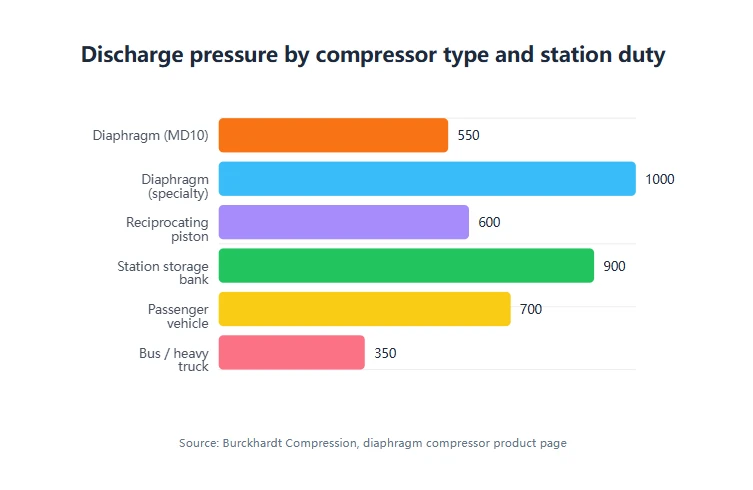
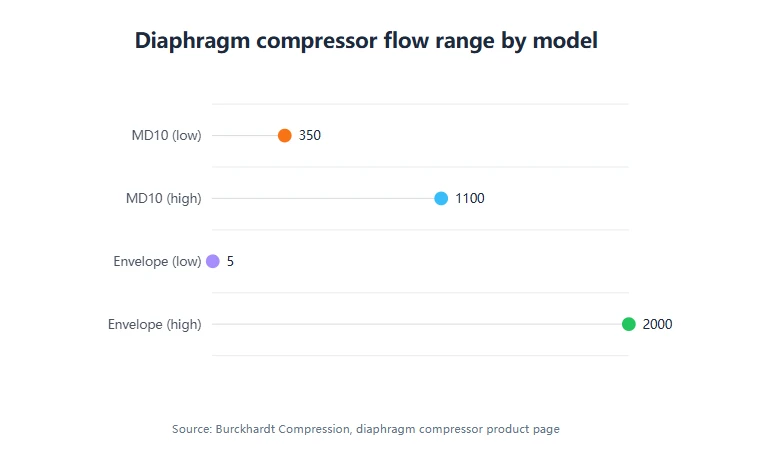
Hydrogen compressor pressure and flow range figures deserve one caution. The widely repeated 5–2,000 Nm³/h diaphragm envelope and the roughly 1,000 bar ceiling trace back to a single upstream review, the 2025 review of diaphragm hydrogen compressors, which vendor pages then paraphrase. Treat those as one source, not many.
Key Takeaway: Three figures on this topic circulate as if independently corroborated but trace to one source each. Check the origin before citing.
Diaphragm units sit at the high-purity end. Burckhardt's MD10 datasheet lists 350–1,100 Nm³/h at 13–40 barg suction and 300–550 barg discharge, with a 4,000-hour mean time between overhauls and oil-free compression stated as compliant with SAE J-2719. The limit is throughput: diaphragm heads suit 2–5 MW pressurized electrolyzer capacity, not tonnage-scale refuelling.
Reciprocating and piston machines cover the widest envelope. PDC Machines' refuelling compressor range states capability up to 1,034 bar, with engineering practice at 350 barg and 700 barg, specialty diaphragm units at 900 and 1,000 barg, and station capacities from 20 kg/day to tonnage per day. The trade-off is pulsation and seal wear, which drive maintenance intervals.
Centrifugal, screw, and liquid-ring options win on throughput and tolerate wet or dirty gas, but reach lower discharge pressures and suit high-purity duty less well. The non-mechanical set, including ionic-liquid piston, electrochemical, metal-hydride, and cryogenic approaches, remains emerging: envelopes are narrow and published operating data is thin, so treat maturity claims as provisional.
Diaphragm Hydrogen Compressors: Where High Purity Decides
Choose a diaphragm hydrogen compressor when the gas must stay oil-free and the flow is modest relative to the pressure. A hydraulically actuated diaphragm flexes against the process gas and seals it off from the hydraulic fluid, so no lubricant ever contacts the hydrogen. That isolation is what makes oil-free hydrogen compression practical rather than aspirational.
The purity target is what forces the choice. Fuel-cell-grade hydrogen under ISO 14687 and SAE J2719 Grade D requires a hydrogen fuel index of at least 99.97%, total non-hydrogen gases below 300 µmol/mol, water below 5 µmol/mol and oxygen below 5 µmol/mol, as set out in Haskel's purity explainer. A compressor that sheds even trace lubricant into the gas stream cannot hold that envelope.
Maintenance is the trade-off. Burckhardt's MD10 datasheet lists a mean time between overhauls of 4,000 hours on that model (Burckhardt Compression), so plan for scheduled diaphragm replacement rather than continuous duty without intervention. Sollant is one of several manufacturers of gas compression equipment, including diaphragm and high-pressure piston compressors, and supports customizable specialty-gas solutions.
The pitfall is specifying "oil-free" without a measurable oil-carryover limit. ISO 8573-1 Class 0 is supplier-defined, so it must be agreed in writing and tied to specific test limits, otherwise the claim cannot be verified after installation.
Reciprocating and Piston Hydrogen Compressors: Duty, Ratio and Pulsation
The reciprocating hydrogen compressor carries most high-pressure, high-ratio gaseous hydrogen duty, and its hydrogen compressor pressure and flow range is wide: 50 to 10,000+ Nm³/h with maximum discharge pressure around 600 bar, according to Pangeng's reciprocating compressor page. The same research round reports a high-end case of 4,800 Nm³/h at 85.9 MPa. Both figures come from vendor and review material rather than independent testing, so treat them as reported capability, not a verified envelope.
The selection question is therefore not whether reciprocating units work, but how three things are managed.
Multistage staging with intercooling sets the specific energy. The Université de Lorraine compression review places advanced compression below 5 kWh/kg H₂, while roughly 5 kWh/kg H₂ is commonly cited for compression to high pressure. The gap between those numbers and a real station is the point: the EFRC hydrogen compression white paper documents one station at 8.3 kWh/kg H₂ from 13 bar suction to 430 bar maximum. That is a single station, not a benchmark, and it should not be used to size another site.
Pulsation is the second check. Piston discharge arrives in pulses, and the resulting pressure fluctuations load the piping, supports and instrumentation downstream, so pulsation dampeners and an acoustic study belong in the specification rather than in post-commissioning fixes.
The third is duty cycle. A station that cycles with refuelling demand rather than running base-load pays a penalty in valve, ring and seal life that a nameplate flow figure does not show.
Centrifugal, Screw and Liquid-Ring Options: Where Throughput Wins
Three of the hydrogen compressor types covered in this guide win on flow and lose on ratio, which is why they sit at the large-flow, modest-ratio end of the value chain rather than at the dispenser. Hyfindr's compression overview places centrifugal machines where throughput is very high and pressure ratio stays modest, and that single constraint explains most of the shortlisting decisions below.
Centrifugal compressors move very large volumes continuously, so they suit pipeline and bulk-storage duty where the discharge target is measured in tens of bar rather than hundreds. Screw compressors, oil-flooded or dry, trade ultimate pressure for steady continuous flow and tolerate wet or dirty gas better than a contacting-seal design. Liquid-ring machines use a liquid seal that handles saturated and contaminated streams, at the cost of a lower achievable ratio and a seal fluid that must be separated and managed.
The purity consequence is the disqualifier. Any oil-flooded or liquid-sealed design has to be assessed against the same oil-carryover limit the diaphragm section defines, because oil-free hydrogen compression is a property of the gas path, not a label on the skid. These families are also the least represented in the hydrogen-specific literature read for this guide, so treat the envelope logic above as a screening filter: no independent performance data was found to support quoting flow or ratio figures for hydrogen duty, and a vendor's own curves should be requested before shortlisting.
Emerging Non-Mechanical Hydrogen Compression: Maturity Boundaries
Non-mechanical hydrogen compression is real, and none of it is a drop-in replacement for a mechanical unit today. Each route has a working envelope and a maturity ceiling, and the gap between the two is what a selection decision turns on.
Electrochemical compression sits at the lower end of the readiness scale. The EFRC hydrogen compression white paper puts average specific energy below 4 kWh/kg H₂, commonly 2 to 4 kWh/kg H₂, and the RWTH Aachen station cost study assesses the technology at TRL 4 to 7, constrained by cell durability, stack cost and throughput rather than by thermodynamics. Metal hydride systems are further along: the 2026 metal hydride review reports a two-stage unit tested from 0.35 to 15 MPa at up to 15 Nm³/h, a three-stage unit commissioned to 160 bar, and delivery pressures above 350 bar in laboratory and pilot systems, with maturity assessed at TRL 6 to 7. Ionic-liquid piston compression has the most striking published number: the ionic-liquid piston study measured roughly 2.7 kWh/kg H₂ raising hydrogen from 0.5 MPa to 100 MPa in five steps, about 25% of a reciprocating unit's specific energy. That figure traces to one 2020 paper repeated downstream, not to independent replication.
How to read a TRL claim: a review paper states the basis for its rating, usually a defined set of demonstrations and their operating hours. A vendor deck often states a number without the basis. Ask which installations, at what pressure and duty cycle, for how many hours, and treat an unsourced TRL as a marketing figure until the underlying test record is produced.
One limitation applies to this whole section. No source read for this run is dated within the last 90 days, and the load-bearing review documents could not be opened by the platform reader, so every figure above is carried as unverified and should be re-checked against the primary documents before it is used in a specification or a business case.
Applications Across the Hydrogen Value Chain
The application sets the envelope, so a hydrogen refueling station compressor and a hydrogen compressor for electrolyzer service are specified against different suction pressures, discharge pressures and purity limits. Electrolysis is the first constraint: alkaline units deliver gas at near-atmospheric pressure, while PEM stacks typically outlet around 8 to 30 barA, and a higher electrolyzer outlet pressure reduces the compression duty downstream. Where purification and drying sit downstream of the stack, the compressor handles both duties at once, and that condition alone rules out families that cannot tolerate wet or contaminated gas.
Refuelling stations show the architecture most clearly. Hydrogen is compressed from low or medium source pressure to storage pressures around 350 bar for heavy-duty fuelling and 700 bar for light-duty fuelling, with some station systems designed for higher discharge or storage pressures depending on architecture, as described on Atlas Copco's station page. Station storage commonly runs at 500 to 900 bar, and the families named most often in that service are reciprocating, diaphragm and hydraulic piston, per Atlas Copco's station pressure table. Storage is arranged as a pressure cascade rather than a single vessel: hydrogen is held in multiple banks so the dispenser draws from the lowest suitable bank first and switches to medium and high pressure banks as vehicle tank pressure rises, with a typical cascade having three banks, as set out in the refuelling-station review literature. That cascade changes the compressor's real duty cycle, since it fills banks intermittently at varying suction pressure rather than running at one steady point.
Table: hydrogen compressor applications, suction and discharge pressure, capacity, purity requirement and fitting families
|
Application |
Suction pressure |
Discharge pressure |
Capacity |
Purity requirement |
Families that fit |
|---|---|---|---|---|---|
|
Alkaline electrolysis outlet |
Near-atmospheric |
Application dependent |
Low to medium |
Moderate to high |
Reciprocating, diaphragm |
|
PEM electrolysis outlet |
About 8 to 30 barA |
Application dependent |
Low to medium |
High |
Diaphragm, reciprocating |
|
Purification and drying combined with compression |
Electrolyzer outlet |
Process dependent |
Low to medium |
High |
Diaphragm |
|
Pipeline and transport |
Medium |
Pipeline dependent |
High |
Moderate |
Centrifugal, reciprocating |
|
Bulk storage |
Low to medium |
Storage dependent |
Medium to high |
Moderate |
Reciprocating |
|
Refuelling station, heavy-duty |
Low or medium |
Around 350 bar |
Medium |
High |
Reciprocating, diaphragm, hydraulic piston |
|
Refuelling station, light-duty |
Low or medium |
Around 700 bar |
Medium |
High |
Reciprocating, diaphragm, hydraulic piston |
|
Industrial and semiconductor off-take |
Low to medium |
Process dependent |
Low |
Very high |
Diaphragm |
Two limits apply. The station pressures come from an equipment manufacturer's own documentation, so they describe that architecture rather than an industry-wide survey, and the cascade description comes from review literature carrying no publication date in the retrieved record. No independent test data comparing these families at matched duty was found, so the final column reflects documented service rather than measured head-to-head performance.
How to Select a Hydrogen Compressor: A Step-by-Step Framework
Hydrogen compressor selection is an eight-step operating-envelope review, and its output is a shortlist plus an acceptance-test specification. Run the sequence a project engineer runs.
- Define the suction pressure range, not a single point.
- Set the discharge pressure and the tolerance around it.
- Convert demand to capacity in kg/h, which fixes the hydrogen compressor pressure and flow range.
- Fix purity and dew point limits.
- Characterise the duty cycle, including start/stop frequency and turndown.
- List utilities and cooling available on site.
- Classify the hazardous area.
- Write the acceptance test before you request quotations.
Work one envelope through the sequence and the eliminations become concrete. Take 20 kg/h at 30 bar suction rising to 350 bar discharge, 99.999% purity, and a duty cycle of four starts per day. Step 3 rules out liquid-ring and screw families on capacity and pressure ratio. Step 4 rules out oil-lubricated reciprocating designs. Step 5 penalises centrifugal, which prefers steady duty. What survives is a diaphragm or a non-lubricated reciprocating machine, and the choice between them turns on the purity tolerance you wrote in step 4.
Keep the completed matrix as the artifact you send to vendors. It converts a vague enquiry into a specification, and it lets you compare quotations on the parameters you set rather than the ones each supplier chose to quote.
Two sections decide what the matrix can actually demand. The materials section explains which alloys and coatings survive hydrogen service, and the standards section lists the codes your acceptance test has to reference.
Hydrogen Embrittlement, Materials and Leak-Rate Acceptance
Hydrogen embrittlement is a materials-selection constraint, not a footnote. Hydrogen dissolves into metals, reduces ductility, fracture toughness and load-bearing capacity, and accelerates fatigue crack growth, so a component can fail below its rated stress.
NETL's materials guidance sets the practical rule: no material above 827 MPa yield strength or Rockwell C 34 hardness where hydrogen partial pressure is high enough or hydrogen concentration exceeds 90 mol%. Austenitic stainless steels, aluminium alloys, copper and copper alloys, and low-strength steels within controlled strength and hardness limits are the commonly accepted families.
Leak-tight means a number, not an adjective. Pfeiffer Vacuum's leak detection compendium defines leak rate as mass flow or volumetric throughput under stated test conditions, measured by pressure-decay or pressure-rise on an isolated known volume, or by tracer-gas and calibrated-reference-leak methods. A hydrogen compressor purchase specification must state the test medium and conditions, the measurement method, a quantified limit with a pass/fail threshold, and traceability evidence: calibrated instruments plus recorded pressure and temperature data.
Key Takeaway: Every leak-rate specification needs four lines: test medium and conditions, measurement method, a quantified limit with a pass/fail threshold, and traceability evidence with calibrated instruments and recorded pressure and temperature data.
Codes, Standards and Certification Requirements
A hydrogen compressor specification becomes comparable only when every offer answers the same clause-level requirements, so the RFQ should name the clause, not just the standard.
Two quality standards sit at the centre of most enquiries. Haskel's purity explainer sets out the ISO 14687 and SAE J2719 Grade D limits that fuel-cell hydrogen must meet, covering impurities such as water, oxygen, helium, nitrogen and total sulphur compounds. Those limits belong to the gas, not the machine, which is why the compressor's own contribution is expressed through ISO 8573-1 contaminant classes for particles, water and oil.
ISO 8573-1 Class 0 is the trap in that conversation. Class 0 is not a fixed number: it is supplier-defined and has to be agreed in writing and tied to measurable limits, otherwise two "Class 0" offers cannot be compared.
|
Standard or scheme |
What it governs |
Evidence to request |
Owner |
|---|---|---|---|
|
ISO 8573-1 |
Compressed-gas contaminant classes (particles, water, oil) |
Test report stating the agreed Class 0 limits and the measurement method |
Package |
|
ISO 14687 / SAE J2719 |
Fuel-cell-grade hydrogen quality, Grade D impurity limits |
Gas analysis certificate for the delivered stream |
Installation, verified at the dispenser |
|
ISO 19880-1 |
Hydrogen fuelling station design, including the compression stage |
Design review documentation and conformity assessment |
Shared: package design input, station-level compliance |
|
ASME (BPVC, B31.3) |
Pressure vessels and hydrogen piping |
U-stamp or equivalent vessel certificate, piping material and thickness records |
Package for supplied vessels and piping; installation for site-run lines |
|
NFPA 2 |
Hydrogen technologies: separation distances, ventilation, detection |
Installation compliance record, hazardous-area classification drawing |
Installation |
|
ATEX / IECEx |
Equipment for explosive atmospheres |
Certificate with scope, marking and validity dates per item |
Package for supplied equipment; installation for field devices |
That table is also the scope boundary, and the boundary is where disputes start: a hydrogen refueling station compressor package can be fully certified while the station-level ISO 19880-1 conformity assessment is still the buyer's to close.
Request certification as certificates, not as a compliance sentence in a datasheet. A certificate carries a scope, an issuing body and validity dates; a datasheet line carries none of those.
Lifecycle Cost: What to Compare Beyond Purchase Price
On a hydrogen compressor duty, purchase price is a minority of what you pay. The comparable line items are specific energy, maintenance interval, spares and seal or diaphragm replacement, and availability. Hydrogen compressor selection therefore turns on a duty-weighted calculation, not a capital quote.
Multiply specific energy in kWh/kg H₂ by your site's actual duty profile rather than the nameplate rating, then add the mean time between overhauls and the labour and lost production it implies. Add the cost of the purity margin: an oil-flooded unit that fails the oil-carryover limit is not the cheaper option once rejected gas and rework are counted. Stations that start and stop carry a further cycling penalty.
Procurement should weigh vendor reliability and spares lead time alongside price, because a long lead time on a diaphragm or seal set converts directly into operations downtime. Grand View Research's market sizing puts the global hydrogen compressor market at USD 1.9 billion in 2024, USD 2.1 billion in 2026 and USD 2.5 billion by 2030 at a 4.6% CAGR, though competing houses disagree on both base value and growth rate, so no single market size should be treated as settled. The Transition Accelerator's techno-economic brief sets out the lifecycle cost structure and compression cost drivers behind these trade-offs.
Key Takeaway: Compare five-year cost across energy, maintenance, spares and downtime, not purchase price alone.
Next Steps
The operating envelope decides the technology, and the acceptance test decides whether you got what you specified. Those two artifacts are the whole decision: the eight parameters from the selection framework, run against the comparison table, tell you which compressor type fits your duty; the leak-rate and materials specification tells you whether the unit that arrives matches what you signed for.
Assemble the eight parameters first. Suction and discharge pressure, flow rate, gas purity, duty cycle, containment class, materials of construction, control and instrumentation interface, and the acceptance test you will witness. Put that one-page envelope in front of any vendor and the conversation changes from brochure claims to engineering answers.
Next step: Request a selection review and talk to an engineer about your operating envelope before you issue a purchase specification.
Sollant is a manufacturer of gas compression equipment, including diaphragm and high-pressure piston compressors, with customizable specialty-gas solutions.
This guide is reviewed against current standards and published performance data. The materials and emerging-technology sections are the ones most likely to change, so check those first when you revisit it.
Frequently Asked Questions
Q: What is a hydrogen compressor?
A: A hydrogen compressor raises hydrogen from a lower suction pressure to a higher discharge pressure so it can be stored, transported, metered or dispensed. The downstream process, not the machine, sets its pressure ratio, purity handling and duty cycle.
Q: Which hydrogen compressor type should I choose?
A: Technology choice is driven mainly by pressure level, flow rate, and whether purification must be combined with compression (Hyfindr's compression overview). Reciprocating machines are reported to cover roughly 50 to 10,000+ Nm³/h at up to about 600 bar discharge, though those figures are unverified and indicative only (the reported reciprocating envelope).
Q: What pressure and flow range can a hydrogen compressor cover?
A: Diaphragm units span about 350 to 1,100 Nm³/h at 13 to 40 barg suction and 300 to 550 barg discharge, with oil-free operation per SAE J-2719 (Burckhardt's MD10 datasheet). That is one family's envelope, not an industry ceiling.
Q: How much does a hydrogen compressor cost?
A: Grand View Research sized the hydrogen compressor market at USD 1.9 billion in 2024, rising to USD 2.5 billion by 2030 at a 4.6% CAGR on a 2024 base year (Grand View Research's market sizing), though competing houses publish materially different figures. Purchase price is only the first line; energy, maintenance, seal replacement and downtime dominate lifecycle cost.
Q: Is oil-free hydrogen compression really necessary?
A: It depends on the end use, not the compressor. Fuel-cell grade hydrogen is capped by ISO 14687 and SAE J2719 Grade D contaminant limits, and lubricant carryover is one route by which a compressor breaches them. ISO 8573-1 Class 0 describes a specific measured result rather than zero oil, so ask for the test method and sampling point.
Q: What is the difference between a diaphragm and a reciprocating hydrogen compressor?
A: A diaphragm compressor seals gas behind a flexing metal diaphragm driven by hydraulic fluid, so the process gas never contacts a lubricated piston, while a reciprocating compressor uses a piston and cylinder with seals the gas does contact. Diaphragm machines suit high-purity, moderate-flow duty; reciprocating machines suit higher flow and higher ratio, where pulsation and seal wear dominate.
Q: Can a hydrogen compressor be used directly downstream of an electrolyzer?
A: Yes, but the electrolyzer's outlet pressure decides how much compression duty remains. Alkaline electrolyzers typically deliver hydrogen near atmospheric pressure, while PEM stacks commonly operate around 8 to 30 barA, so an alkaline installation needs a much larger pressure ratio from the same downstream compressor.
Q: What materials are used in hydrogen compressor construction?
A: Austenitic stainless steels, aluminium alloys, copper alloys and low-strength steels are the usual choices, bounded by the widely applied limits of 827 MPa yield strength and Rockwell C 34 hardness for steels in hydrogen service. Hydrogen embrittlement reduces ductility and can crack high-strength steels under cyclic pressure, so a stronger material is not automatically safer.
Conclusion
The operating envelope, not the technology label, decides which hydrogen compressor fits a given duty. Every family in this guide occupies a defined band of pressure ratio, flow, purity and duty cycle, and the selection work is matching your parameters to that band rather than choosing a name.
The guide's spine is short enough to carry into a vendor conversation. The type comparison sets the envelopes side by side; the application map shows where each one lands across the value chain; the eight-step framework and its worked example turn suction and discharge pressure, capacity in kg/h, purity and dew point, and duty cycle into a shortlist; the materials and leak-rate section fixes the specification that embrittlement risk imposes; the standards set names what a supplier must certify; and the lifecycle comparison moves the decision past purchase price.
Two parts of this guide will age fastest. The emerging non-mechanical options are not yet drop-in replacements for mechanical compression, and public performance data on them remains thin, so treat any maturity claim as provisional. Re-check the materials and standards sections against the current revision before an RFQ goes out.
Ready to define your operating envelope? Bring your suction and discharge pressure, capacity, purity and dew point, and duty cycle, and Sollant, a manufacturer of gas compression equipment including diaphragm and high-pressure piston compressors with customizable specialty-gas solutions, can be used to review a configuration against those parameters. Request a selection review.
Continue Learning
Return to the type comparison for the envelope bands, the selection framework for the eight steps and the worked example, the materials and leak-rate acceptance section for the specification language, the codes and standards section for the certification set, and the lifecycle-cost comparison for the total-cost model. Those five sections are the artifacts to take into a vendor conversation.
Last refreshed: September 2026
This guide is published by Shanghai Sollant Energy Saving Technology Co., Ltd., a manufacturer and supplier based in China that develops and produces gas compression equipment, including screw and piston compressors and specialized systems for oilfields and nitrogen generation. Its work covers diaphragm and high-pressure piston compressor technology and customizable compression solutions for specialty gases, which is the subject area this article addresses.