

A plant or system specifier comparing a centrifugal package against a screw package for a defined duty runs into the same wall early: centrifugal vs. screw compressor efficiency is not one number. A bare percentage comparison between the two classes is invalid, because the test codes do not define a shared metric. CAGI data sheets cross-reference ISO 1217 for displacement machines and ISO 5389 for turbo compressors, so the two figures are not measuring the same thing (CAGI Electric Handbook, chapter 8, 2020).
There is a second reason a single efficiency figure misleads. Isentropic efficiency depends strongly on pressure ratio and operating point, so a value quoted at one condition says little about performance at another (polytropic compression reference).
What follows is a criteria-by-criteria decision framework. The answer turns on flow, pressure ratio and load profile, not on which machine class is inherently better.
What centrifugal vs screw compressor efficiency actually measures
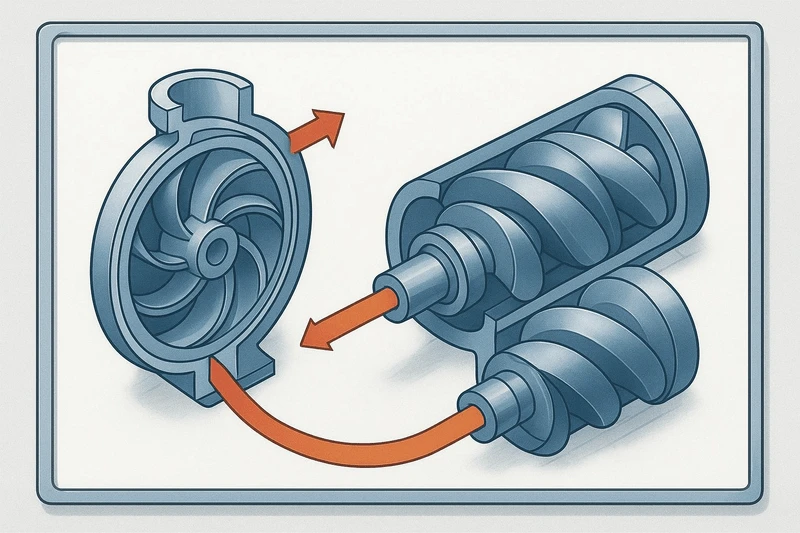
Efficiency in this comparison means three different things, and they are not interchangeable. The first is specific power, defined as input power divided by delivered flow, measured at the package boundary at a stated discharge pressure. When specific-power figures are taken from published or supplier-provided data, the stated inlet conditions, discharge pressure, flow reference, measurement boundary, and test method should be checked before comparing values from different sources.
The second is polytropic or isentropic efficiency, which compares actual compressor work with the work of an ideal reversible adiabatic process between the same inlet and outlet states. These efficiency definitions are useful for engineering analysis, but they should not be treated as interchangeable with package-level specific power. The applicable efficiency definition, calculation method, and test conditions should be stated when comparing technical data from different suppliers.
Key Takeaway: A bare "% efficiency" claim cannot be compared across the two classes. For displacement compressors, ISO 1217:2009 provides acceptance-test methods covering volume flow and power requirements. ISO 1217:2009 remains the current published edition, while ISO is currently developing a new edition. Where a contractual performance guarantee is involved, the applicable edition and test conditions should be stated explicitly in the purchase specification.
Quick comparison: efficiency criteria at a glance
Centrifugal vs screw compressor efficiency is not one number. It is a scorecard, and the criteria below decide most industrial selections. Read it as a framework for your own duty, not as a verdict.
|
Criterion |
Centrifugal |
Rotary screw (oil-flooded) |
Rotary screw (VSD) |
|---|---|---|---|
|
Best-fit duty |
Baseload at 100% of nameplate airflow |
Variable demand with modest turndown |
Trim load against a baseload machine |
|
Full-load specific power |
16–20 BHP/100 CFM at 100 psig, the lowest of the major classes |
18–22 BHP/100 CFM |
18–24 BHP/100 CFM; worse peak, better system efficiency |
|
Part-load behaviour |
Poor below nameplate |
Falls back to inlet modulation and load/unload below roughly 40–50% of rated flow |
Speed control tracks demand down to the drive's minimum |
|
Turndown limit |
Effectively none |
About 40–50% on turn-valve control |
Widest of the three, set by motor and drive limits |
|
Oil-free capability |
Inherently oil-free air path |
Requires a separate oil-free design |
Requires a separate oil-free design |
|
Maintenance profile |
Rule of thumb: fewer wearing parts, higher cost per intervention |
Rule of thumb: more frequent routine service, lower cost per intervention |
Rule of thumb: as oil-flooded, plus drive electronics |
|
Typical size range |
Rule of thumb: larger flows |
Rule of thumb: small to mid flows |
Rule of thumb: small to mid flows |
|
Dominant loss mechanism |
Rule of thumb: impeller and diffuser losses away from design point |
Rule of thumb: clearance, oil carryover and unloading losses |
Rule of thumb: motor, drive and converter losses |
The full-load figures come from an energy-efficiency consultancy's comparison of full-load and part-load performance across the major compressor classes, which draws on U.S. DOE and Compressed Air Challenge data. Part-load limits follow best-practice guidance on part-loaded compressed air systems.
Two cautions before you use this table. First, the BHP/100 CFM bands are class-level rules of thumb at 100 psig, not guarantees for a specific package; a quote's own performance data always outranks them. Second, the rows marked as rules of thumb are engineering judgement, not measured values, and belong on your supplier question list rather than in your specification as settled facts.
Key Takeaway: Centrifugal leads on full-load specific power; screw with speed control leads on part-load and turndown. Which one wins depends on where your load profile actually sits.
Full-load specific power: which machine uses less energy at design point
At the design point and at high flow, a centrifugal package generally posts the lowest specific power of the major compressor classes, but the margin is narrower than most vendor literature suggests and it moves with discharge pressure.
How we use this in project selection: We normally request the customer's guaranteed operating point first, then check whether the compressor will operate continuously at that point or across a wider flow range. For a stable, near-design operating point, full-load specific power can be highly relevant. For plants with significant flow variation, however, the annual operating profile can be more important than the single full-load number.
Application experience: don't compare kW alone
In a real compressor quotation, we compare at least four items together:
- Required flow and pressure at the actual gas conditions
- Specific power at the contractual operating point
- Expected annual operating hours and load profile
Maintenance, cooling, oil-free requirements, and gas compatibility
This prevents a catalogue efficiency number from becoming the only selection criterion.
An energy-efficiency consultancy's comparison of full-load and part-load performance across the major compressor classes puts centrifugal machines at 16 to 20 BHP per 100 CFM, against 18 to 22 for a fixed-speed screw and 18 to 24 for a VSD screw. The gap comes from the compression mechanism itself: a centrifugal stage converts impeller velocity into pressure with no sliding contact and no internal leakage path, while an oil-flooded screw loses energy to tip clearance leakage, oil churning and the compression heat the oil absorbs.
Specific power benchmarks published against the Chinese mandatory-efficiency standard GB 19153-2019 show screw performance varying widely with pressure ratio and rating, which is why a single quoted figure rarely survives contact with a real duty.For current project evaluations, the applicable standard edition and scope should be confirmed rather than assuming that a previously published reference applies unchanged to every compressor model or application.
One unit trap: BHP/100 CFM and kW/(m³/min) are not interchangeable, and the two sources above use different units. Convert both quotes to the same basis before comparing them.
Part-load behaviour: where the efficiency ranking reverses
A machine that wins at design point can lose badly at the load you actually run. Best-practice guidance on part-loaded compressed air systems puts it bluntly: centrifugal machines suit baseload operation at 100% of nameplate airflow and "nothing else", while a variable-speed rotary screw is the correct trim machine. The mechanism sits in the control strategy. A centrifugal compressor cannot throttle below its surge line, the low-flow stability boundary where flow separates from the impeller, so capacity control below that point is achieved by blow-off or recycle: the machine keeps spinning and keeps consuming power to move gas that serves no process. A screw with a turn valve holds capacity down to roughly 40 to 50% of rated flow before falling back to inlet modulation and load/unload cycling, which is why the ranking flips as load falls. For a fuller picture of how the two machine types behave away from their design point, a Purdue compressor-conference study that compared the part-load efficiency characteristics of the two machine types mapped fixed-speed and variable-speed screw and centrifugal compressors on a head-flow map using efficiency islands, including variable-diffuser-geometry centrifugal cases and low-oil variable-speed screw cases (Brasz, ICEC 2006, paper C142).
In actual projects, this is one of the first questions we ask customers: "What percentage of the rated flow will the compressor operate at most of the time?" A compressor selected around a 100% design point can look excellent on a full-load comparison but may have a very different annual energy profile if the plant normally operates at 50–70% load.
Turndown and control strategy: VSD, inlet guide vanes and blow-off
Turndown, not peak efficiency, usually decides the selection. A machine that wins at design point but cannot follow the load will be run in a way that destroys the advantage it was bought for.
On screw compressors, variable-speed drive is the control strategy that preserves part-load performance. In the specific power benchmarks published against GB 19153-2019, VSD screw specific power is better than fixed-speed across the 7.5–75 kW range at 0.8 MPa, which is why VSD screws hold their efficiency as flow falls rather than losing it to load/unload cycling.
Centrifugals are controlled differently: variable-geometry inlet guide vanes adjust the inlet flow angle to keep the impeller matched as flow drops. That helps, but only so far. Reported findings on inlet guide vane losses at part load put vane losses at less than 25% of the total part-load efficiency drop, with the impeller and diffuser responsible for more of it. The practical consequence is blunt: an IGV retrofit does not rescue a centrifugal that is being asked to trim.
⚠️ Warning: If your load profile requires a centrifugal to run well below its design flow for long periods, inlet guide vanes will not recover the lost efficiency. Size the trim duty for a screw, or accept the penalty.
Total cost of ownership: energy dominates, but not only energy
Energy is where the money goes. Atlas Copco's life-cycle cost model for an industrial compressor puts energy at 76% of total cost, investment at 14% and maintenance at 10% (Atlas Copco, "What no one tells you about life cycle cost of compressors"). Treat that split as a vendor illustration, not an audited benchmark: the page discloses neither its methodology nor the electricity price behind it, and the ratio moves with tariff, running hours and load profile.
That is why compressor total cost of ownership is decided mainly on specific power and part-load hours, not on purchase price. The U.S. Department of Energy's compressed air sourcebook, produced with the Compressed Air Challenge, estimates 20 to 50% savings potential from system-level measures, but that range covers the whole air system, not the package alone, and it is not restated on the linked page.
Maintenance and overhaul timing still change the ranking for some duty cycles. A machine with a lower first cost and a longer interval between major overhauls can close a specific-power gap over a fifteen-year horizon, particularly where running hours are low.
Flow, pressure ratio and load profile: the break-even in practice
There is no universal CFM cutoff, and the published guidance disagrees with itself. One set of commercial comparison pages puts the crossover at "usually above 200–300 HP or 1,000+ CFM"; another puts the most cost-effective centrifugal range at "above roughly 6,000 CFM" (compressor type comparisons, undated). Neither page could be read in full, so treat both as competing rules of thumb rather than a specification. The size ranges they imply do agree on one thing: centrifugal machines typically span 200–5,000+ HP while rotary screw spans 5–600 HP, so the overlap band is where the decision is genuinely open.
Use a procedure instead of a number:
- Map the duty cycle: hours per year at each flow and pressure ratio, not a single design point.
- Obtain part-load specific power for each quoted machine, from the manufacturer or from a witnessed test.
- Multiply each load band by its hours to get annual energy, then apply your electricity tariff.
- Compare the result against standard-derived specific power benchmarks published against GB 19153-2019, and check whether the quoted machine sits above or below the grade its duty implies.
- Re-run the comparison at 60% and 40% of design flow. If the ranking flips, the load profile decides, not the technology.
For distributors running this comparison across a mixed installed base, the fourth step is also the fastest way to spot a quote that will not survive a customer's own energy audit.
Specification and testing: how to compare two quotes fairly
Two quotes are comparable only when flow and power were obtained under the same test code and corrected to the same guarantee conditions. The acceptance-test standard that governs how a screw compressor's flow and power are measured, ISO 1217 Annex A, permits a ±2.5% tolerance on measured air delivery, while input power measured to IEC 62053-22 class 0.5 carries a ±1% tolerance (Deman). Those bands are wide enough that two machines with identical nameplate figures can differ by several percent in real specific power, so the tolerance must be stated, not implied.
The scope division matters just as much. CAGI data sheets cross-reference ISO 1217 for displacement machines and ISO 5389 for turbo compressors, with ISO 11011 governing the system-level energy assessment rather than the machine (CAGI). Comparing a screw compressor's ISO 1217 sheet against a centrifugal's ISO 5389 figures is a category error unless both are corrected to the same inlet, discharge and cooling-water conditions. For selection, API 617 and API 619 define the centrifugal and rotary screw service envelopes respectively (API), but they are scope documents, not performance guarantees.
Key Takeaway: Write the test code, the correction basis and the guarantee conditions into the inquiry itself. Distributors and OEMs reselling into a mixed installed base carry the specification risk when a quote is accepted on nameplate data alone.
Who should choose which
Rather than choosing a compressor type based on flow rate alone, the selection should consider the actual gas conditions, pressure ratio, operating profile, and required operating range. In our compressor selection work, we compare the customer's normal, minimum, and maximum operating conditions with the proposed compressor's performance data before evaluating efficiency or lifecycle cost.
High-flow, steady baseload - centrifugal may be a strong candidate
Centrifugal compressors can be attractive when the required flow is high and relatively stable and the operating point remains within the machine's efficient operating range. The final selection still depends on gas properties, pressure ratio, required turndown, and the compressor's actual performance curve. Any published efficiency or power figure should be checked against the current manufacturer documentation and the same operating conditions before being used for comparison.
Lower or variable flow - screw may be worth evaluating
Screw compressors can be useful where the application requires a wider practical operating range, frequent load variation, or a compact positive-displacement solution. The actual part-load curve should be reviewed before making an efficiency comparison. Where performance figures are taken from supplier materials, the model, document revision, test conditions, and whether the figure is guaranteed or indicative should be verified, particularly when the source does not provide a publication date.
Oil-free or gas-contamination-sensitive service - evaluate the complete gas path
For oil-free requirements, compressor design, sealing, lubrication arrangement, downstream filtration, and gas compatibility should all be considered. "Oil-free" should not be treated as a standalone purchasing criterion. For specialty gases, gas composition, allowable contamination, material compatibility, and sealing requirements may also affect compressor selection. Supplier-provided specifications should therefore be evaluated together with the actual gas-service requirements rather than used as universal benchmarks.
Next steps
Map your own duty cycle first: the load profile, the pressure ratio band and the hours per year at each operating point. That single exercise decides which machine wins on your site, and it is the input any supplier needs before quoting.
With that profile in hand, the useful next step is a conversation rather than a brochure. Talk to an application engineer about how the duty cycle maps onto a specific selection, and ask to review the technical documentation behind the quoted specific power figures, including the test standard and the correction method used.
Sollant supports industrial compressor selection for distributors and end users, and can be used as one of the options you evaluate against the criteria above.
Frequently Asked Questions
Q: Is a centrifugal compressor more efficient than a screw compressor?
A: Only in the conditions where its efficiency advantage actually applies. At full load and high flow, centrifugal compressor efficiency is generally the stronger of the two on specific power, because a single high-flow impeller stage moves a large volume with relatively little loss. At part load, that ranking generally reverses, since the screw machine's positive-displacement action holds its volumetric efficiency as flow falls while the centrifugal stage loses it. The honest answer to any centrifugal vs screw compressor efficiency question is therefore "it depends on load profile", and the load profile is the first thing to establish before comparing quotes.
Q: Can I use a screw compressor as the trim machine for a centrifugal?
A: Yes, and it is the standard architecture for a part-loaded system. Best-practice guidance on part-loaded compressed air systems puts the centrifugal machine on baseload and a variable-speed screw on trim, so the trim machine absorbs the swing while the centrifugal runs near its design point. The pairing works because the two control strategies are complementary rather than competing. What it requires is genuine integration: a common controller that sequences the machines, shares the pressure setpoint, and prevents the trim unit from fighting the centrifugal's inlet guide vanes.
Q: Which compressor type has lower maintenance cost?
A: Maintenance is a smaller line than most buyers assume. The manufacturer's own life-cycle cost model puts energy at roughly three-quarters of total cost and maintenance at about 10%, which means the maintenance comparison rarely decides the purchase on its own. Overhaul timing is where the two classes genuinely diverge, and the intervals are not interchangeable between a centrifugal and a screw. Ask each OEM for the documented overhaul interval and scope in writing rather than accepting a verbal estimate, because that interval drives the long-run maintenance line more than routine servicing does.
Q: Does the answer change for oil-free or gas compression duty?
A: The metric logic does not change, but the option set narrows. An oil-free requirement removes the oil-flooded screw from consideration and leaves oil-free screw or centrifugal as the realistic candidates, which is where oil-free gas compressor selection usually starts. The same criteria still decide the outcome: full-load specific power, part-load behaviour, turndown, and total cost of ownership. What changes is the weighting, since sealing, materials and contamination control carry more weight in gas duty than in plant air.
Verdict: criteria winners and the decision rule
The honest answer to "so which one wins?" is that no single machine wins every criterion, and the centrifugal vs screw compressor efficiency question only resolves once you name the load profile.
|
Criterion |
Stronger option |
Why |
|---|---|---|
|
Full-load specific power |
Centrifugal |
Higher flow in a smaller frame at design point |
|
Part-load behaviour |
Screw |
Centrifugal efficiency falls away from design point |
|
Turndown |
Screw |
Wider stable range before blow-off or recycle |
|
Oil-free capability |
Centrifugal |
Oil-free by design, no downstream filtration |
|
Maintenance profile |
Centrifugal |
Fewer wearing parts over a long service life |
|
Total cost of ownership |
Load-profile dependent |
Energy dominates, so part-load hours decide it |
For a plant running near-continuous duty at a stable design point above roughly 1,500 m³/h, centrifugal is the stronger choice on specific power, oil-free integrity and maintenance. For a site with swinging demand, frequent starts or a design point below that band, a screw machine, ideally variable-speed, holds its efficiency where the centrifugal cannot.
Decision rule: choose centrifugal when your load sits at or near design point for most operating hours, and screw when your load profile moves. If the answer is still unclear, the next step is to send both quotes back with your actual load-duration curve attached and ask each supplier to state specific power at 100%, 75% and 50% flow.
Technical References
- ISO 1217:2009, Displacement compressors - Acceptance tests.
- ISO 1217:2009/Amd 1:2016, Calculation of isentropic efficiency and relationship with specific energy.
- ISO 5389:2005, Turbocompressors - Performance test code. American Petroleum Institute (API), relevant compressor standards including API 617 and API 618, where applicable to the compressor service.
- GB 19153-2019, Minimum allowable values of energy efficiency and energy efficiency grades for displacement air compressors, where applicable to the relevant air-compressor application.