

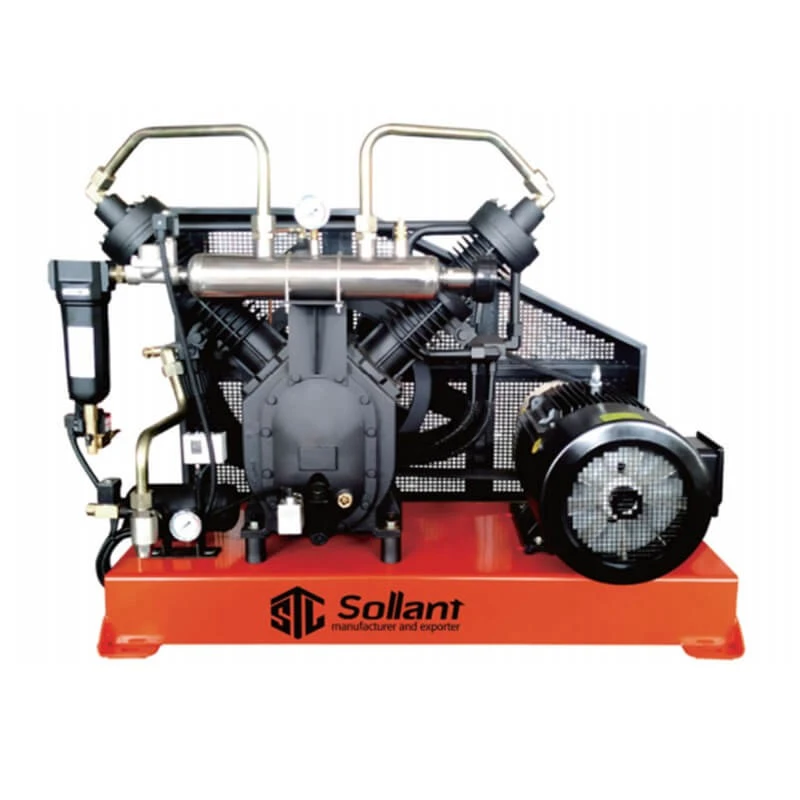
22KW High Pressure Booster Compressor
High pressure booster compressor for petrochemical and firefighting applications, easily installs with existing systems, offers stable air and energy efficiency.
Model: 66WZ
Inlet Press: 1.0Mpa
Disc Press: 2.5-4.0Mpa
Flow: 6.0m³/min
Pwr: 22kw
Product Overview
This unit is an air-cooled booster air compressor specifically designed for industrial high-pressure gas supply applications. Featuring integrated valve technology, it combines high-efficiency compression, intelligent control, and safety protection. With a compact structure and stable operation, the unit is suitable for both continuous-load conditions and systems requiring frequent start-stop cycles; it ensures stable output while significantly reducing energy consumption and maintenance costs.
Key Component Highlights
We recognize that the reliability of a booster air compressor hinges on the robust performance of every single component. To this end, we have spared no expense in adopting the following high-specification features:
Moving away from traditional multi-piece assembly methods, we utilize a single-piece cast housing structure. This design significantly enhances structural rigidity while ensuring precision-grade concentricity for the crankshaft and perfect perpendicularity between the crankshaft and cylinders. The unit remains rock-solid during high-speed operation, fundamentally minimizing vibration and wear.
We employ heavy-duty roller bearings instead of conventional ball bearings. Although individual roller bearings weigh two to five times more than ball bearings, they deliver vastly superior load-bearing capacity and impact resistance. In actual operation, these bearings offer a longer service life and reduced noise levels, making them ideally suited for the high-frequency, high-load rotational conditions typical of booster compressors.
Patented Dual-Shaft Sealing Design: Utilizing a dual-barrier sealing structure, this design effectively eliminates the micro-leakage issues common to single-seal systems-even under extreme pressure fluctuations-thereby multiplying seal durability.
Fully Bearing-Equipped Connecting Rod Mechanism: High-precision bearings are installed at both the big and small ends of the connecting rod. By completely eliminating traditional sliding bearing shells, we have drastically reduced frictional heat and mechanical losses. This configuration lowers the failure rate of the connecting rod assembly by a factor of two to six, setting a new industry benchmark for reliability.
Technical Specifications for High-Pressure Booster Compressor

Wide Range of Applications
Power generation industry:
Supplies stable, clean control air for gas turbines and boiler ignition systems.
Water treatment engineering:
Provides oil-free compressed air for aeration tanks and backwashing systems.
Defense and aerospace:
Meets the extreme requirements for air purity and pressure stability in precision pneumatic equipment.
High-end manufacturing:
Laser cutting, PET bottle blowing, electronic component placement, etc.
Why Choose Us?
- Reasonable Pricing: Through technical optimization and economies of scale, we offer highly competitive end-user prices while maintaining import-grade quality.
- Suitable for Diverse Applications: Whether you require pneumatic valve assemblies for corrugated board production lines or air supply for high-pressure test benches, our equipment delivers stable output and precision tuning to perfectly meet your operational needs.
- Full Lifecycle Service: We provide comprehensive technical support-ranging from model selection guidance and installation/commissioning to preventive maintenance-ensuring you can purchase with confidence and operate with peace of mind.
FAQs
Q1: What safety protection mechanisms are in place when the equipment starts up?
To ensure the safety of both operators and the equipment, the unit is typically equipped with multiple protection devices:
- Pressure protection: Includes safety valves at various stages and automatic shutdown/alarm systems triggered by overpressure in the intake or discharge lines.
- Temperature protection: Real-time monitoring of discharge temperature to prevent lubricant coking or component damage caused by excessive heat.
- Oil pressure and water flow protection (for water-cooled models): Ensures adequate lubrication and proper cooling water circulation.
Q2: What are the common reasons why a high-pressure booster compressor fails to reach its discharge pressure?
Failure to reach the set discharge pressure is usually caused by gas leakage, insufficient intake, or system mismatch issues. Common causes include:
- Valve failure: Wear, deformation, or breakage of intake/discharge valve plates, or carbon deposits/foreign objects on sealing surfaces, leading to imperfect valve closure and gas backflow.
- Piston ring and cylinder liner wear: Severe wear or excessive clearance in high-pressure stage piston rings causes high-pressure gas to leak downward (blow-by), reducing effective discharge volume and pressure.
- Intake system obstruction: Severe clogging of the intake filter or piping results in insufficient intake volume, thereby affecting the final discharge pressure.
- Inter-stage cooling and pressure leakage: Minor leaks in stage safety valves, poor sealing at pipe joints or flanges, or a damaged discharge check valve. Excessive downstream gas demand: Actual on-site gas consumption exceeds the compressor's rated discharge capacity.
Q3: What should be checked if the operating noise of a high-pressure booster compressor suddenly increases?
A sudden increase in operating noise usually signals loose or worn mechanical components or abnormal airflow. It is recommended to focus inspections on the following areas:
- Valve assembly: Check for broken valve plates or failed springs. Valve plate damage is often accompanied by abnormal metallic "clacking" sounds or hissing airflow noises.
- Moving mechanism clearances: Check for excessive clearance-caused by wear-in connecting rod bearings (big/small ends), crosshead pins, or crankshaft main bearings, which can produce mechanical knocking sounds.
- Loose fasteners: Check for loose cylinder head bolts, frame anchor bolts, or stage piping supports that could cause resonance or component-on-component impact.
- Poor lubrication: Check the oil pump's operating status and oil level. Insufficient lubrication or oil degradation can lead to dry friction between moving parts, resulting in sharp, abnormal noises.
Q4: What are the installation environment requirements for a high-pressure booster compressor?
To ensure long-term, stable operation and facilitate future maintenance, the installation environment must meet the following requirements:
- Solid and level foundation: The equipment should be installed on a level, solid concrete foundation and secured with anchor bolts in accordance with specifications; specialized vibration-damping pads should be installed if necessary to minimize vibration transmission.
- Proper ventilation, temperature, and humidity: The installation site must provide adequate ventilation and heat dissipation (especially for air-cooled models); the ambient temperature should generally be maintained between 5°C and 40°C, and the unit should be protected from direct sunlight and rain.
- Sufficient clearance: Adequate space (typically at least 1 meter) must be reserved around the equipment to facilitate routine inspections, filter element replacement, air valve removal, and major overhaul operations.
- Environmental cleanliness: Airborne dust, corrosive gases, and moisture should be minimized; if the operating environment is poor, an intake pre-filtration device must be installed to prevent accelerated mechanical wear.
Hot Tags: 22kw high pressure booster compressor, China 22kw high pressure booster compressor manufacturers, suppliers, factory, 11KW high pressure booster air compressor, 22KW high pressure air compressor boosters, 30KW High Pressure Booster Air Compressor, 75 110KW oil free booster air compressor, High Pressure Combi Booster Air Compressor, high pressure piston compressors


